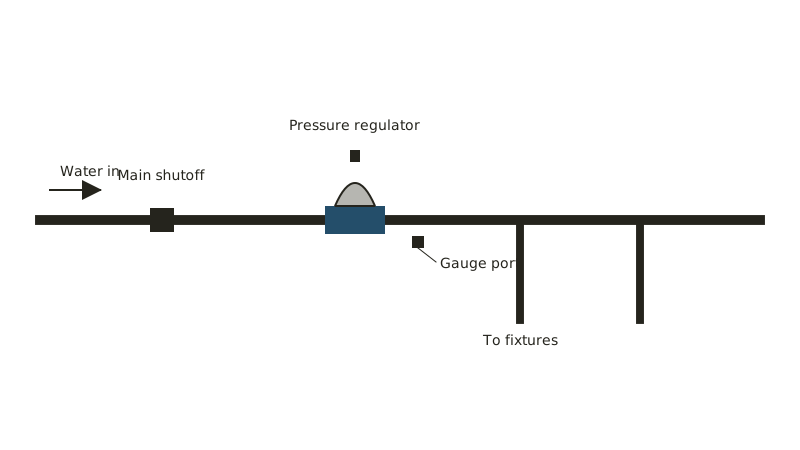
Where do you usually find the pressure regulator?
Begin just downstream of the valve that closes off the whole house. Around Long Beach the regulator is often tucked next to the heater, under the floor, against a garage wall, or in a small buried box near the front of the lot. Look for a brass dome with a bolt on top, sitting in a straight run of pipe. Symptoms of pressure trouble are covered under plumber for low water pressure.
A practical way to search: start at the meter by the curb, follow the buried line toward the building, and look at whatever it meets first. Normally that is the shutoff valve, then the regulator, also called a PRV, short for pressure reducing valve. If nothing dome-shaped turns up, the house may simply not have one. The later section on testing explains how to find out for sure.
What does a water pressure regulator look like?
Expect a small brass bell, often smaller than a grapefruit, set into the line. A bolt or screw crowns the top under a locknut. Some have a tapped port for a gauge. An arrow cast into the metal points the way the water travels, and a stamped date can reveal how old the unit is.
Several other fittings live nearby and get mistaken for it:
- Shutoff valve: a wheel or lever that turns the water off completely, usually upstream.
- Heater relief valve: a small spring valve on the tank with a pipe leading down toward the floor.
- Expansion tank: a squat blue or gray vessel that hangs off the cold pipe near the heater.
- Backflow assembly: a bigger fitting with two or three valves, found on sprinkler or fire lines.
- Spigot vacuum breaker: a tiny cap on the outdoor faucet.
A bell with an adjusting bolt on top is the regulator, and nothing else on that list looks like it.
Where should you look in different kinds of Long Beach homes?
Layout drives location. A slab house tends to keep it in the garage or a side-yard box, a bungalow on a raised foundation often tucks it under the floor near the front wall, and hillside or older harbor-area houses may mount it beside the heater or on an outside wall. Treat that as a tendency and trace the pipe to be sure.
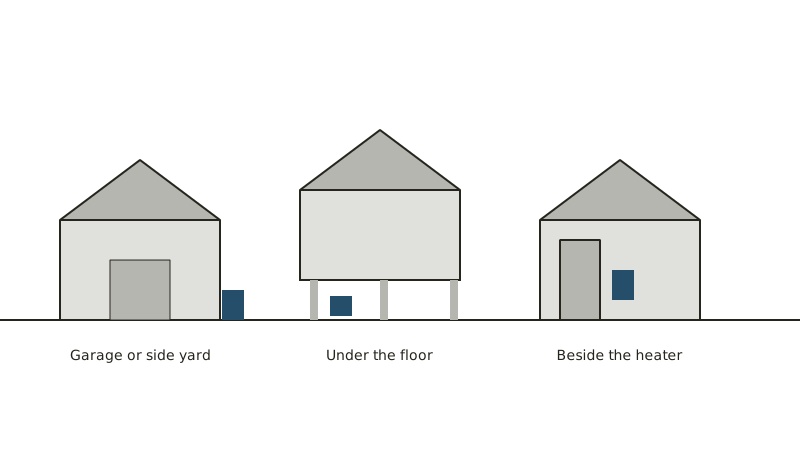
A sensible search order:
- Garage walls. Start on the street-facing side, near the heater or the laundry connections.
- Yard boxes. Look for a plastic or concrete lid near the foundation, or a riser pipe with a bell fitting under it.
- Crawlspace. Look where the line passes through the foundation, with a flashlight and someone nearby.
- Utility closet. The heater closet is a frequent hiding place.
- Curb box. That one is the utility's meter. Long Beach Utilities' rules end its responsibility at the meter, so any regulator beyond it is the owner's.
Cottages from the 1920s to 1950s in Belmont Shore, Bixby Knolls and Naples frequently never got a regulator, or lost it in a later remodel, or still run one that quit years ago. A crawlspace entry may need a plumber's help.
How can you tell if the house has a regulator at all?
Look at the supply pipe between the entry point and the first branch for a dome fitting. If you see none, thread a gauge onto an exterior sillcock while every indoor tap is shut. A reading above 80 psi with no regulator in view suggests one is missing or dead, because the state plumbing code asks for one above that number.
An inexpensive gauge from a hardware store is enough. Shut every tap and appliance, open the spigot beside the gauge and read the dial. Late evening often shows the peak, since neighbors use less water then, and a reading that creeps up overnight hints that a regulator is failing.
Some houses sit where the utility delivers a moderate pressure and never need one. Others are low on the system and see high readings. Only a measurement tells you which you have.
What next, once the regulator is located?
Observe first. Write down the brand and model, check the bell for drips, listen for whining or banging, and take a pressure reading. Do not turn the bolt unless you understand the procedure. An old unit that drifts, hums or seeps from its body is a candidate for replacement.
Adjusting means freeing the locknut and nudging the bolt in small increments, gauge attached; setting a regulator valve shows the sequence. When a valve will not hold a steady number or leaks from the bell, the normal cure is a new one. Read water pressure regulator replacement and the figures in regulator installation cost.
Fitting a regulator can add a second requirement, an expansion tank, because warmed water needs somewhere to expand once the line is sealed off. The reasoning is in expansion tank replacement.
When is it time to call a plumber about the regulator?
Book a visit if you cannot locate one, the gauge passes 80 psi, pipes bang or whine, or the bell is corroded or wet. Installing one means splicing into the supply, which is regulated plumbing work, and jobs worth $1,000 or more fall under California's contractor licensing rules.
On site, the plumber reads the pressure, dials the regulator to a comfortable setting and fits an expansion tank where one is called for. Use the quote form to tell us about the house; we arrange a local plumber, and the price is on paper first. Someone answers Monday through Friday, between nine and five. The Harbor Lights home page shows how visits are arranged.
Pressure that runs high unnoticed wears out toilets, faucets and the heater early. Banging is covered in water hammer sounds, and the opposite problem in low pressure causes.
Common questions
Is the regulator inside or outside the house?
It can be either. Some live in an outdoor box near the front foundation, and some inside, in a garage, crawlspace or closet. Trace the supply pipe from where it reaches the building and look for a dome-shaped fitting just beyond the whole-house shutoff.
Does every house have a pressure regulator?
Not every one. A home on a gentler part of the system may not need one, and older houses sometimes never had one or lost it during a remodel. The state plumbing code expects one when static pressure is over 80 psi, which makes a gauge reading the quickest test.
What if I find a regulator but cannot turn the main off?
Do not muscle a seized valve. One that will not budge needs replacing anyway, which is plumber work. If water is escaping and nothing closes, phone a plumber immediately. Trouble before the meter, out by the curb, goes to Long Beach Utilities at (562) 570-2390.
Can I install a regulator myself?
The job involves cutting the supply pipe, setting the pressure and frequently adding an expansion tank, so most owners hire it out. A permit may be needed, and contractor work from $1,000 up requires a California license. A small regulator that screws onto a garden hose is a different, simple part.
What does a failed regulator sound or feel like?
Typical signs: high or jumping pressure, a hum in the line, banging pipes, a heater relief valve that leaks and fixtures dying early. Pressure that climbs overnight is another clue. Measurement settles it, and a new unit is usually the fix.
References
Updated