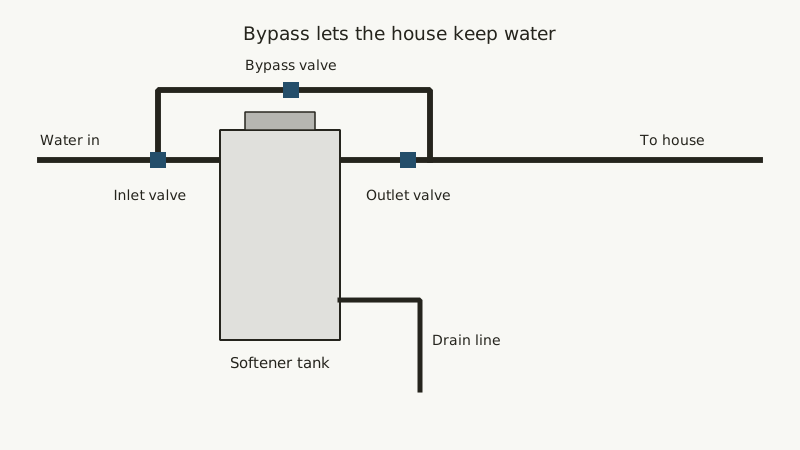
Inside the tank, resin beads grab the calcium and magnesium dissolved in hard water and release sodium or potassium in return. A plumber connects the tank to the supply pipe close to the point where water enters the building, with a bypass valve, a drain connection, an electrical outlet and a city permit rounding out the job. Our other jobs are collected on the Harbor Lights front page. What follows runs from deciding whether you need one through to the invoice.
Is the water in Long Beach hard enough to justify a softener?
Your street's source decides it. The 2025 water quality report from Long Beach Utilities splits the system into two zones. In one, hardness averaged 220 mg/L, roughly 12.8 grains per gallon and firmly in the very hard class. In the other it averaged 76 mg/L, roughly 4.4 grains, which counts as moderately hard.
The figures are the utility's own, so ask it which zone covers your address before spending money. The same report says roughly 71 percent of the water is local groundwater and about 29 percent is imported surface water, blended at a treatment plant, which is why the mix on any one street can drift.
By the usual classification, anything above roughly 7 grains is hard and above about 10.5 is very hard. Around 4 grains, spotted glassware may be the only sign. At 12 or 13, expect white crust on faucets, a furred kettle and a heater laboring under scale. San Pedro and Wilmington are supplied by LADWP, so their hardness comes from a different report.
What actually happens on the day a softener goes in?
Water goes off, the line is cut close to the main, and the softener is mounted with a bypass valve so the household keeps running water if the unit ever has to be isolated. Next come the drain run to an approved waste connection, power, programming for your hardness, a first regeneration and a leak check.
The details are what make a good install. Sizing comes from the hardness figure and the number of people at home, since a household of two on 13-grain water needs a different unit than a family of six. Thumbtack's guide says a 32,000-grain unit suits most houses, with big homes going higher. The drain needs an air gap, the tank belongs on a level base, and plenty of installers keep the outdoor spigot line on raw water, because irrigation does poorly on softened supply.
Expect the visit to take a half day for a straightforward house, longer when pipe has to be run across a garage or attic. Our longer write-up on whole-house softener installation steps through the sequence in more detail.
Do I need a permit in Long Beach?
Normally, yes. Long Beach states that a plumbing permit comes first for installing, altering or replacing equipment that heats or treats water, and inspection must happen before anything is covered up. Owners who live in a one- or two-family home can apply for their own work under the city's stated conditions, though contractors generally take care of it.
Find out whether a quote bundles the permit fee and inspection. An unpermitted install can resurface as a headache at a home sale. For current rules and fees, Long Beach Building and Safety is the office to ask; homes in San Pedro and Wilmington answer to the LA city building department instead.
What does the whole job cost?
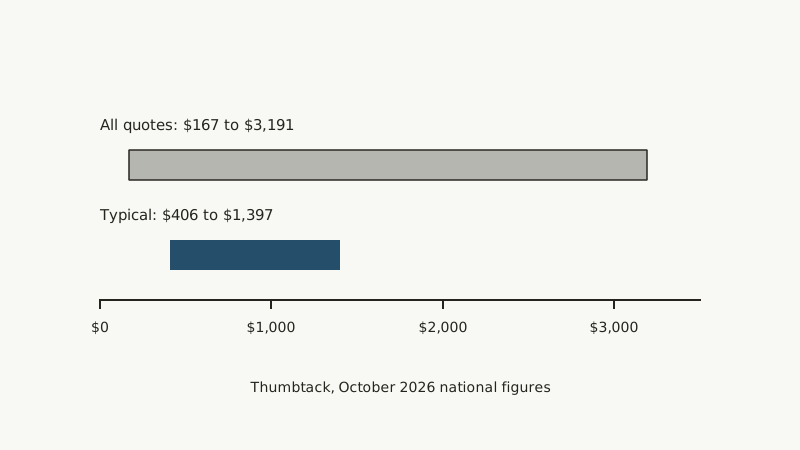
As a guide, Thumbtack's October 2026 national figures put a softener installation at $406 to $1,397, with $167 at the bottom and $3,191 at the top. A basic salt-based unit runs $400 to $1,000 on its own, and installation labor adds more. How far the pipe must travel, and where the main sits, explain most of the gap between low and high.
A Thumbtack pro in Arizona quoted $250 for a home already pre-plumbed for a softener, $350 when the main is easy to reach, up to $750 where pipe must be run around the house or through an attic, and $1,200 where trenching is needed. Those are one contractor's examples, not Long Beach prices, so treat them as a sense of scale. Add the permit.
Ongoing costs matter too. Salt-based units use salt, roughly $5.50 for a 40-pound bag in Thumbtack's data, and potassium costs more. Our page on softener installation cost breaks the money down further.
Is the plumbing different for a loop, a brand-name package or a showerhead filter?
Brand rarely changes the pipework. Whether the box says Whirlpool, Rheem, Kinetico, Aquasana or a dealer package like Culligan, the unit needs an inlet and outlet, a bypass, a drain and power. The control head, tank size and the manufacturer's clearance and setting instructions are what vary, and the installer works from those.
Some newer houses come with a softener loop, meaning capped stub-outs beside the main, ready to receive a tank some other year. Where one exists, labor falls. Retrofits in older Belmont Shore and Bixby Knolls bungalows rarely have it, and the pipe behind may be galvanized steel that deserves a look before anything is cut into it. See galvanized pipe replacement for that decision.
A screw-on showerhead cartridge is a different product. It treats a trickle of water at one outlet, and we would not expect it to do what a whole-house unit does.
Can I install it myself, and is a salt softener allowed?
Many owners handle it themselves with a kit, and the Long Beach rule allows an owner-occupant to pull their own permit. The danger is a weak joint at the main, or a drain line with no air break. If you hire it out, ask for the permit and inspection in the quote.
As for rules, no statewide ban on brine softeners exists in California. Under Water Code section 13148, qualifying local sewage agencies may restrict self-regenerating units by ordinance following a public hearing, and a few inland communities have. We did not find a Long Beach restriction, so confirm with the utility or the city before you buy, because rules can change. Salt-free conditioners do not use brine, but the Thumbtack guide notes they suspend minerals instead of removing them, and the minerals can still settle in the water heater.
What else changes after a softener goes in?
Water feels slick and soap lathers better, and fresh scale stops forming, though the old crust stays put. For crust already on glass and fixtures, see our notes on removing hard water scale. Watch the bill, too. A softener stuck in endless regeneration appears on the utility's own list of high-bill causes.
Softened water carries added sodium, with potassium chloride as the alternative, so anyone on a strict low-sodium diet should ask a doctor. The encyclopedia entry on softening says the EPA regards harm from softened water as unlikely, and that it is unsuitable for irrigation. If your water bill jumps after installation, read why water bills run high before assuming the worst.
Common questions
Is the install a morning job or an all-day one?
Plan on a few hours when the main is easy to reach. Longer pipe runs, trenching or old galvanized lines turn it into a full day. For part of that time the taps will be dry. The city's inspection is its own step, booked once the work is in.
Should the softener treat the hot water only?
One design softens only the hot side, which shields the heater and leaves drinking water untouched. It is a design choice and it adds pipework. The softening article on Wikipedia mentions it as a way to limit scale in water heaters. Most households still go whole-house.
Does a softener make the water taste salty?
Usually not in any way you would taste. Ion exchange adds sodium or potassium as it removes hardness, so sodium climbs slightly with moderately hard water and further with very hard. People limiting sodium should check with a doctor, and the unit can be run on potassium chloride.
What should the quote include?
Look for the unit and its capacity, the bypass, the drain connection, any new pipe, the permit with inspection, and a line on salt. Ask which hardness figure drove the sizing. Pricing hinges on your main and pipe, so name your zone when you ask for a figure on the quote page.
More in this guide
- Removing hard water scale
How to remove hard water scale from faucets, showerheads, glass and water heaters, what Long Beach water hardness means, and what stops it…
- Whole-house softener installation
How a whole-house water softener is installed in Long Beach: where it goes, sizing, drain and power needs, permits and local rules on salt…
- Softener installation cost
What a water softener installation costs in Long Beach: equipment, labor and permit ranges, salt versus salt-free, brand questions and how…
References
- Long Beach Utilities, 2025 water quality report (hardness by zone)
- Thumbtack, water softener installation cost guide (updated October 2026)
- City of Long Beach, plumbing permit requirements
- California Water Code 13148, local control of residential self-regenerating softeners
- Long Beach Utilities, high water bills (softeners that cycle continuously)
- Wikipedia, Water softening
- Wikipedia, Hard water
Updated