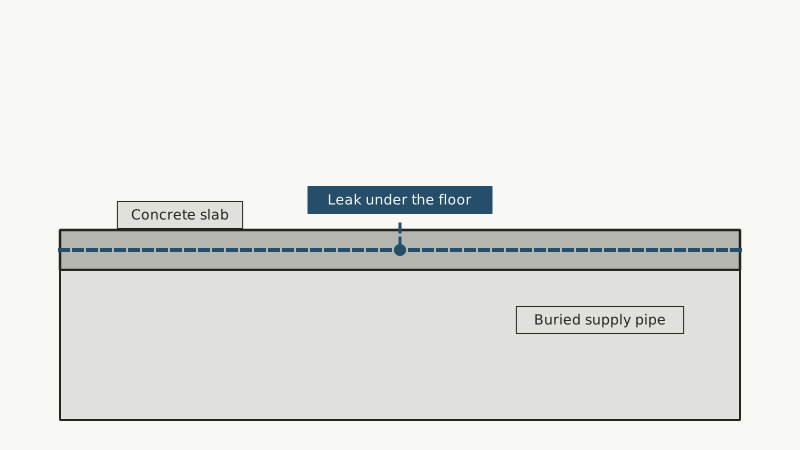
Pick a spot repair when one line has quit and the rest tests healthy. Choose a repipe if the leak is the second or third of its kind, or the pipe is old enough that others are bound to follow. That is the whole decision in two sentences, and a plumber's leak location report is what settles it. More services are listed on the home page. For background on how leaks get traced in the first place, start at our leaks overview, then use the sections below to compare the options.
Do I patch the leak under the floor, or replace the pipes altogether?
The answer turns on how often the pipe has failed and what metal it is. One leak in otherwise healthy copper usually justifies a local fix. A second leak within a few years, a house full of pipe from the 1950s or earlier, or any galvanized steel line argues for replacing the whole system.
Think of the repair as a bet. Spot work gets rid of today's puddle at a modest price, and the bet pays off if the surrounding pipe has decades left. When corrosion has thinned the metal everywhere, the same crew may return in six months for the next hole, and each visit includes cutting and patching concrete again. Plumbers often propose a camera or pressure test of the remaining lines before you commit, and each path's price is on the slab leak repair cost breakdown.
What are the ways to reach and fix a pipe beneath concrete?
Four methods exist. One opens the slab directly over the break and swaps the damaged piece. Another tunnels under the foundation to approach from the side. A third runs a new line overhead or inside walls and abandons the buried one. The fourth lines the pipe's interior with epoxy. The plumber proposes one once the leak is located.
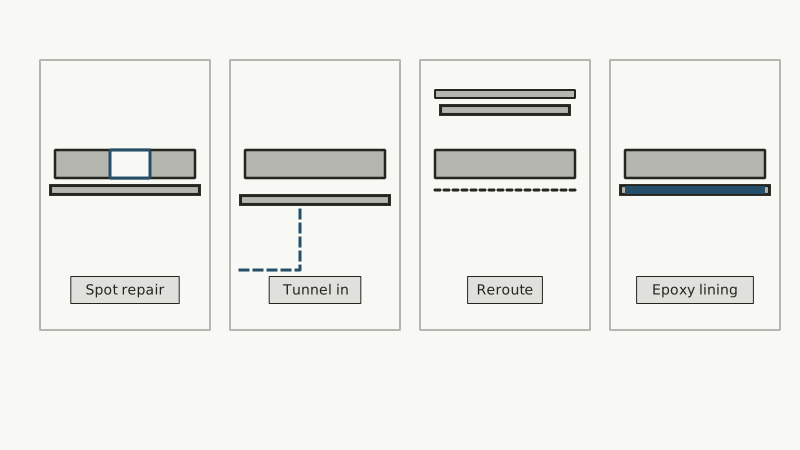
Breaking the slab is the quickest and the messiest; the patch needs concrete, and then flooring, to be rebuilt. Tunneling avoids the floor but is rarely a small job. Rerouting spares the concrete entirely, and its cost swings with how much exposed run there is to rebuild, which is why published figures for it disagree so widely. Epoxy lining suits some pipe in decent condition and does not suit badly corroded runs, so ask the plumber for a reason, not only a recommendation. Locating a buried break is its own subject, see telling whether a line has failed underground.
What does each option cost?
Published guides vary a lot, so treat these as a rough frame. Angi's 2026 guide puts slab leak repair between about $630 and $4,400, with detection typically $150 to $400. HomeGuide lists spot repair at $700 to $5,000, epoxy lining at $500 to $3,500 and rerouting at $3,900 to $7,500, while Angi's rerouting range is lower.
| Path | Published range | What pushes it up |
|---|---|---|
| Leak detection | $150 to $400 | Large or multi-level layout |
| Spot repair through the slab | $700 to $5,000 | Pipe depth, flooring, location in the house |
| Epoxy lining | $500 to $3,500 | Pipe condition and length |
| Reroute | $3,900 to $7,500 (one source) | Distance and wall or attic access |
| Repipe of the entire house | Angi lists $1,500 up to $15,000 | House size, material, drywall repair |
Add the build-back: HomeGuide cites about $6 to $12 per square foot for concrete replacement, and Angi lists restoration from $300 to $10,000 or more. The last row has its own breakdown in whole-house repipe pricing. Nothing in this table is a quote; a written price comes after a plumber sees the house.
What tells me the water is escaping below the floor?
Look for a handful of tells. Your water bill climbs although nobody changed habits. The meter turns when every fixture is off. A patch of floor feels warm, a carpet or laminate board is damp, grout cracks open, or you hear water running in a silent house. Any combination calls for professional leak detection.
Long Beach Utilities describes the basic meter test: close everything that uses water and watch the meter, then look again after two hours. A spinning dial means water is going somewhere past it. Hot-water-line leaks announce themselves with warm floors and a water heater that never rests. Moisture under flooring can also grow mold, and EPA guidance leans toward a professional when mold covers more than a 3-by-3-foot area. Do not remove baseboards or slabs yourself; let detection pinpoint the location first.
When does a whole-house repipe make more sense than another patch?
When the pipe has proven it is failing. Repeat leaks in one system, pinholes in different rooms, brownish water, sagging pressure, and old galvanized or polybutylene pipe are the strongest signals. Newer copper with a single leak is the case where a patch stays sensible.
Local conditions play into it. Plenty of Long Beach bungalows built between the Jazz Age and the 1950s keep their first pipe, and postwar tract neighborhoods are often plumbed in copper that has now seen decades of service. The city's 2025 water report lists blended-zone hardness around 76 ppm and 220 ppm in the other zone, and and opinions differ on how much water chemistry shortens copper life, so ask what the removed pipe looked like inside. Related reading: how a repipe is carried out, the PEX versus copper debate and a repipe in PEX.
Is a permit involved, and does insurance help?
Usually a permit, and sometimes insurance. The City of Long Beach requires a plumbing permit when piping is installed, altered, repaired or replaced, with an exemption only for stopping a leak without new materials, so a slab repair or repipe with new pipe normally needs one and an inspection. Insurance depends on the policy.
The state insurance department lists abrupt, accidental water damage as generally covered, while gradual leakage, wear and maintenance problems are generally excluded. Some policies pay for damage a slab leak caused, such as ruined flooring, but not for the pipe or for tearing into the concrete to reach it. Call the insurer before the concrete is opened, take pictures, and ask what the policy says about access costs. For the questions to put to an adjuster, read homeowners insurance and slab leak repair. After you have the facts, ask for a quote and the plumber confirms the scope on site.
Common questions
For how long is the floor opened up on a slab leak job?
Spot repairs and lining jobs often wrap up within two days, then the concrete has to cure before flooring returns. A whole-house repipe commonly stretches over several days, with the supply shut for part of each. The plumber should attach a schedule to the written quote, and drying or restoration can run beyond the plumbing itself.
Which questions belong in the conversation before I approve anything?
Ask how the leak was located, which of the four methods is proposed and why, whether the city permit and inspection are included, who restores the floor and wall finishes, and what the price covers. Check the contractor's license number at cslb.ca.gov. Request the scope and total in writing before anyone starts breaking concrete.
Must I be on site while this is going on?
Have an adult there at the outset to show the main shutoff and agree where work will happen, and again at the final walkthrough. During a spot repair, being reachable matters more than being in the room. For a repipe, plan on the house being disrupted for days, with water off at times and drywall open.
Can the leak just be left alone for a while?
No. A buried leak keeps wetting the soil, the slab and the flooring, and the water bill keeps climbing. Mold can start in damp materials, and a hot water line that leaks also runs the heater nonstop. Shut off the main if the damage is spreading, and have the leak located before deciding between repair and repipe.
References
- Angi, how much slab leak repair costs (2026)
- HomeGuide, slab leak repair cost
- City of Long Beach, plumbing permit requirements
- Long Beach Utilities, high water bills and leak checks
- Long Beach Utilities, 2025 water quality report
- U.S. EPA, Mold Cleanup in Your Home
- California Department of Insurance, residential insurance guide
Updated