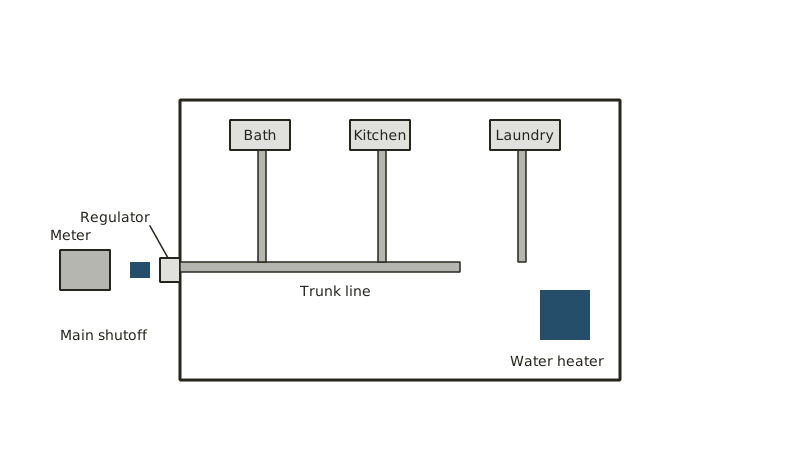
Repiping a house means running new supply pipe from the shutoff at the meter to each tap, toilet and appliance, and then taking out or abandoning the old lines. A typical job takes a few days of work with the water on and off in stretches. How hard it turns out to be comes down to the way the house was framed. Torn between a repipe and spot repairs? Start with the repiping overview, which frames that choice.
What does the work look like from the first visit to the final patch?
Someone tours the rooms, tallies fixtures and chooses routes for the new lines. Next come the permit, a shutoff, small cuts in drywall, new pipe run and tied in, and a pressure test before walls are closed. After the inspector signs off, patching begins.
Here is the order, as published contractor timelines describe it:
- Walkthrough and written price. Fixture count, floors, access and pipe material all feed the number.
- Permit. Long Beach requires a plumbing permit for replacement piping.
- Rough-in. New lines go in through the attic, crawl space, garage or opened walls. Fixtures are shut off one zone at a time when possible.
- Tie-ins and testing. The new system is connected at the meter side and checked under pressure for leaks.
- Inspection. Work must be inspected before it is covered or put into service.
- Patching. Wall openings are filled. Many contractors leave painting to the owner, so confirm what is in the price.
Contractor pages generally describe two to five working days for a typical house, plus a day or two for drywall repair. Treat that as a guide: a one-story bungalow with an accessible attic goes quicker than a two-story house with plaster walls.
What changes for a slab-on-grade foundation?
In a slab house the supply lines may run in the attic, in the walls or beneath the floor. Where they are under the concrete, the usual plan is to leave them and run replacements across the attic and down into the walls, rather than jackhammer the floor. Breaking the slab is the alternative: noisier, dustier and pricier.
Rerouting overhead means more wall openings, one for each drop to a fixture, so budget for more drywall work. It also leaves the old buried pipe in the ground, which is normal practice and not a hazard. Fixing one leaking line under the floor is a lighter job than redoing the whole house. Slab leak repair versus repiping walks through how to choose.
Postwar tract houses in Lakewood and the Harbor area are often slab-on-grade, so this question comes up locally. Older bungalows in Belmont Shore and Bixby Knolls more often have raised floors and a crawl space, which makes the pipe work easier to reach.
Should I repipe with PEX or with copper?
Both are accepted in California. The state building standards commission cleared PEX for the California plumbing code after an environmental impact review wrapped up. PEX is bendable, snakes through framing with few joints and normally runs cheaper. Copper brings the longer history, and sun or rodents bother it less.
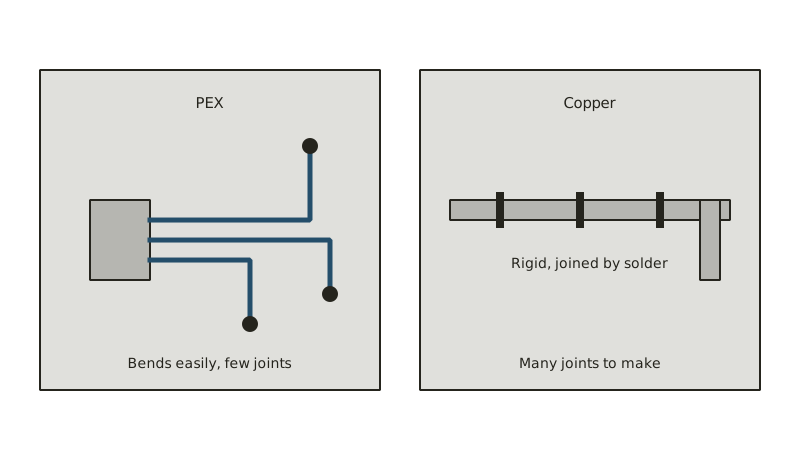
How the install differs:
- PEX. Long continuous runs of tubing branch from a central manifold or run in a trunk-and-branch layout. Connections are made with crimp rings or cinch clamps and a tool. Our walkthrough on repiping with PEX goes into the details.
- Copper. Rigid pipe is cut, fitted and joined with solder or brazing, which means many more joints and an open flame in a house. That is slower work and part of why copper costs more.
Long Beach lists its own materials limits. Check the permit page for what applies to your job, and read PEX versus copper for the full comparison, including cost ranges.
Is it realistic to do this job myself in Long Beach?
The City will issue a permit to an owner who lives in a one- or two-family home and does the work personally, if the owner signs a statement about not employing workers subject to California workers' compensation rules. That is the rule, not a recommendation. A repipe is long, physical, and it is judged by inspection and a pressure test.
Think about what a mistake costs. One bad joint inside a closed wall can soak a room, and the home then carries water damage and a repair history. People with plumbing experience do take on a straight run, such as a short extension. A whole-house repipe is where most owners hire it out.
Hiring out? The state board's contract rules apply: a written agreement for jobs over $500 that names the contractor's license number, lists the payment schedule, and keeps the first payment at or under $1,000 or ten percent of the contract, whichever is the smaller number. Verify the number on the board's website first.
Must the family leave, and what should be cleared beforehand?
Most families stay home. You lose water during working hours in stretches, and some contractors restore it each evening, while others need it off longer, so ask when you request the price. Keep some drinking water, plan showers elsewhere, and expect noise, dust and strangers in the attic.
Preparation helps the crew move fast:
- Clear space around every fixture and under each sink.
- Empty closets and cabinets that sit against walls to be opened.
- Make attic and crawl-space access clear, and move stored items.
- Put plastic over furniture and take wall hangings down.
- Secure pets, and mention any known hazards in the attic, such as old insulation.
Asbestos can occur in older materials, such as some pipe wrap and wall products in 1920s through 1970s homes. If a plumber suspects it, work should stop until it is tested and handled according to the rules, and the EPA publishes guidance for homeowners. Do not sweep or vacuum suspect debris yourself.
How do I know which old pipes need replacing?
Look at what you have before you call. A magnet clings to galvanized steel but skips copper and plastic. Gray or brown crust at fittings, rust-tinted water from the first draw of the day, or feeble flow at several fixtures can all signal corroding steel. Gray plastic from the late 1970s and 1980s may be polybutylene.
Each of those has its own page: galvanized pipe replacement, polybutylene replacement, and the wider old-house plumbing replacement guide. A lone pinhole in copper rarely settles the question, although repeat leaks usually do. For dollar figures, open the repipe cost page; a written scope comes from the quote form.
Common questions
For how long will the taps be dry?
Contractor timelines vary. Some describe water off for one working day at a time and restored in the evening, and others keep a main line off longer. The overall job is typically a few days. Ask your contractor for a day-by-day plan in writing, so you know when to plan showers and laundry.
Does repiping mean wrecked walls?
Some openings are expected. The count depends on access: attic or crawl-space routes cut fewer holes, while a finished two-story house with plaster walls needs more. Openings are patched afterward, but paint and texture matching may not be included. Ask whether drywall patching and paint are part of the quote.
Is a permit really needed to replace the pipes?
Yes. Long Beach requires a plumbing permit before replacement piping starts, and the work has to be inspected before it is covered. A contractor normally pulls it. Other cities and Los Angeles have their own rules, so a house in San Pedro or Wilmington follows the Los Angeles building department instead.
Is a partial repipe possible?
It is. One failed section, say a kitchen branch or a bathroom group, can be swapped while the rest stays. It makes sense when the other pipes are in good shape. If several areas have leaked or the pipe material is a known problem, a full repipe tends to cost less in the long run.
This guide is one of many on Long Beach plumber.
References
- City of Long Beach, plumbing permit requirements
- City of Long Beach, permit questions
- Contractor Magazine, California approves PEX for state plumbing code
- California Contractors State License Board, home improvement contracts
- Published repipe timelines from several California plumbing contractors, checked November 2026
Updated