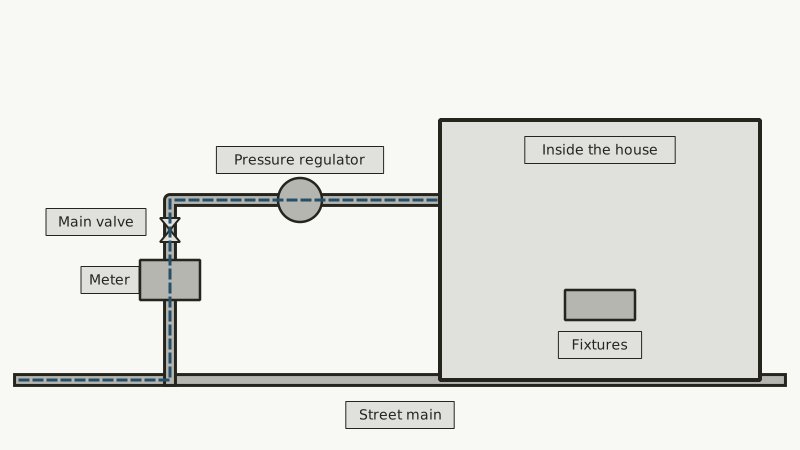
A weak shower rarely has a mysterious cause. Six suspects cover nearly every case, and you can clear the cheap ones before lunch: a crusted aerator costs nothing, a stuck regulator costs a visit, and a leak costs more every week you ignore it. Go down the list in order. If the culprit turns out to be hidden in the wall or the yard, the low-pressure plumber page shows how that visit goes and who owns which part of the system.
What makes the water in a house lose its push?
The six, from most to least frequent: scale-clogged fixtures, a valve that was never opened fully, a tired regulator, a hidden leak, steel pipe narrowed by rust, and trouble on the street side of your meter. Households usually find the answer among the first three.
Scale is the local angle. In its 2025 report, Long Beach Utilities lists average hardness near 220 ppm for one supply zone and near 76 ppm for another, so nozzles choke sooner where the water is harder. Galvanized steel, still behind plenty of walls built before about 1960, rusts closed from the inside. A drop that happened overnight deserves its own read: see sudden pressure loss.
Is it the city, the pipes under my house, or a single faucet?
Three quick looks sort it out. Count how many outlets are weak. Knock next door and compare. Then close every tap, read the water meter, and see whether its low-flow dial still creeps. If it does, water is leaving through your side of the line. Allow roughly a quarter of an hour for all three.
Ownership splits at the meter: the utility looks after everything up to and including it, and you look after the rest. People in the city of Long Beach can phone (562) 570-5700 for residential leak help. In San Pedro and Wilmington the supplier is LADWP, and your bill names who to call. The EPA's own leak test is a two-hour wait, all water off.
Why would just the shower or just the hot taps be weak?
One weak outlet points at that outlet. Suspects: scale in the showerhead, a stop valve not fully open, a kinked flexible hose, grit in a cartridge. If cold flow is fine and hot is not, the heater and the pipes leaving it become the focus, since hot and cold travel separate routes.
A vinegar bath loosens scale in a showerhead or aerator. More detail lives in the pages on shower pressure and hot-side trouble. Sediment piled in an old tank can throttle the outlet, so a heater that is many years old and a strong cold tap together make a lead worth chasing.
Could a worn regulator or a half-shut main be the cause?
Both are inexpensive to test. The main valve, a lever or round handle where the line enters the property, may have been left part-closed by earlier work. The regulator is a bronze-colored bell fitted to that same pipe. It wears with age and, when failing, can wander either direction.
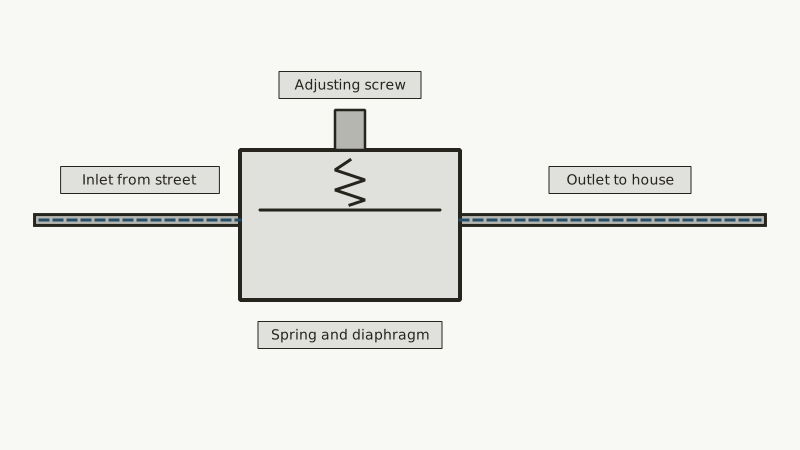
California's plumbing code demands a regulator wherever pressure in the supply piping tops 80 psi, so many local homes carry one. Screw a pressure gauge to a hose bib outside and read it. Below about 30 psi, suspect the regulator, the valve or a leak. Finding the device is covered in where the regulator sits, tuning in adjusting the regulator, and the bill in regulator installation cost.
Can low pressure hurt anything, or anyone?
Not directly. The danger lies in what it signals. A concealed leak can soften framing, aging pipe can split without notice, and a whole street losing pressure can point to a main break. EPA figures a typical household loses over 9,300 gallons annually through leaks, so weak flow paired with a bigger bill needs chasing.
If the utility posts a notice for your block, follow it. Dips also make tankless heaters and some appliances sulk, a nuisance not a hazard. Excess pressure is the worse direction because it strains fittings and hoses. To trace a leak through the numbers on your bill, read why a water bill jumps.
When does a plumber become the right call?
Hand it off when the spigot gauge reads low, when several outlets are weak and the meter will not sit still, when the water comes out rust-brown, or when working near the main valve makes you uneasy. One visit can pressure-test several points, examine the regulator and listen for a leak.
Whatever the cause, resist the urge to crank the regulator screw up in the hope of more force. Over 80 psi the code treats pressure as excessive, and a regulator set high sends the strain to every fixture, hose and water heater connection in the house. A tidy fix leaves the number in a sensible middle band.
Jot down which taps are weak, whether hot and cold both are, the start date and your gauge reading, and attach it to the request. The contractor should show a California license number, and replacing pipe normally calls for a city permit. The quote page is where to begin.
Common questions
How weak is too weak, in numbers?
Under about 30 psi on a gauge, fixtures feel feeble. Many homes sit between 40 and 60 psi and feel fine. Code frets about the other extreme: past 80 psi a regulator becomes mandatory. If the reading looks healthy but flow is poor, suspect a single fixture or one branch.
Can a gummed-up aerator weaken a whole sink?
At that faucet only. Unscrew it, rinse out the grit, and soak it in vinegar if it is crusted. If flow stays poor with the aerator off, the trouble sits further up that line or in the small stop valves beneath the sink, with the remainder of the home unaffected.
Does a softener cut pressure?
A correctly sized, maintained unit should not. A clogged resin tank, a plugged filter or a bypass valve left half shut can. If flow weakened after treatment equipment was installed or serviced, begin there, and have the installer look at it.
Will it recover without help?
If street work or a temporary surge in demand caused it, probably. A worn regulator, a stuck valve or a corroded pipe will not heal. Neighbors unaffected and a weak flow lasting past one day means it is worth tracing.
The rest of our guides start from Harbor Lights Plumbing.
References
Updated