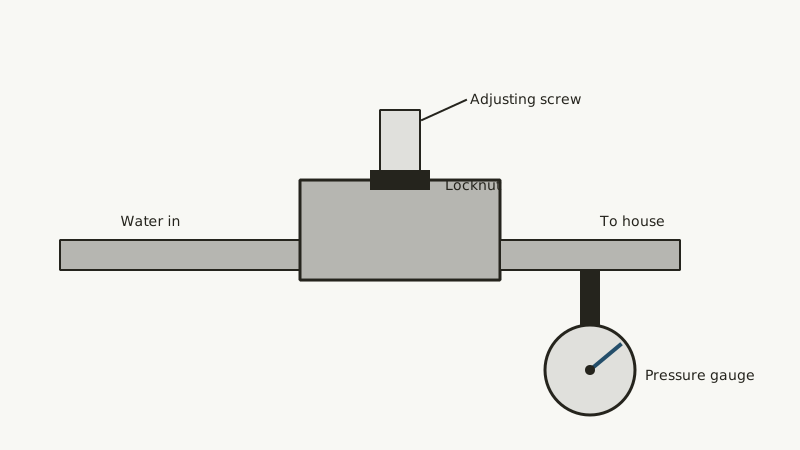
You turn a regulator's adjusting screw only after you have read the pressure on a gauge, because the dial on the valve is not accurate. Clockwise raises the outlet pressure, the other direction lowers it, and each adjustment should be small. Everything about leaks, noise and weak showers is covered under low water pressure, and this page is the hands-on part for a Long Beach house.
What is the job of the valve on the main line?
Often labeled a pressure reducing valve, this device is installed installed just inside the building boundary, after the point of entry. Its task is keeping the pressure inside lower and steadier than the pressure in the street. A spring and diaphragm inside open and close the valve as demand changes. Without one, high street pressure reaches every faucet, toilet and appliance.
Variants turn up under different names. A household water pressure regulator and a water pressure reducer regulator are the same device. A brass bell-shaped body with a bolt or screw on top is the classic look, and Watts is one of the better-known makers of the type. Inline versions screw onto a garden hose bib to protect a hose or sprinkler, and a small one sometimes sits behind a showerhead, though that is really a flow restrictor and does not govern the whole house.
Pumps need their own controls. A well or booster pump uses a pressure switch and tank rather than a regulator on the street side, so adjusting a regulator is not the cure for a pump problem. The low pressure guide sorts the causes.
Where is the regulator in a house?
Begin at the main shutoff, which is typically where the supply pipe emerges from the ground or wall. Around Long Beach that spot might be by the meter box out front, beside the house, or inside the garage. Plenty of older homes never got one. A brass bell with a single pipe entering and another leaving is the thing you want.
Do not take a shovel or a hammer to the property if the line is buried or sits behind drywall. The regulator location guide shows typical spots, and a tradesperson can track one down fast. Homes with a hillside lot, such as parts of San Pedro, often put the valve at the lower side of the house where the supply enters.
How do I measure the pressure before touching the valve?
Screw a cheap gauge onto an outdoor hose spigot, close every fixture in the house and read the dial. Many household fixtures are designed to work at roughly 40 to 60 psi, and the plumbing code approach in California treats anything above 80 psi as too high at the building. Take a reading at night too, since pressure can rise when nobody is using water.
A reading above 80 psi means a regulator is expected. Summaries of the state plumbing code describe a valve that brings the supply to 80 psi or under. Section numbers shift between editions, so have the installer or the city confirm the wording currently in force. Over time, strong pressure wears out washer hoses, ice maker lines and heater tanks.
A reading well below 40 with the valve fully open points elsewhere. Suspect a clogged aerator, scaled-up galvanized steel or a main that is only part open, and read our sudden low pressure article goes through it.
What are the steps to adjust a pressure regulator valve?
With the gauge still on, back off the locknut at the top of the valve, then rotate the adjusting screw: clockwise adds pressure, counterclockwise takes it away. Go in small increments. Run a tap for a moment so the spring settles, look at the dial, and lock the nut once it reads what you want.
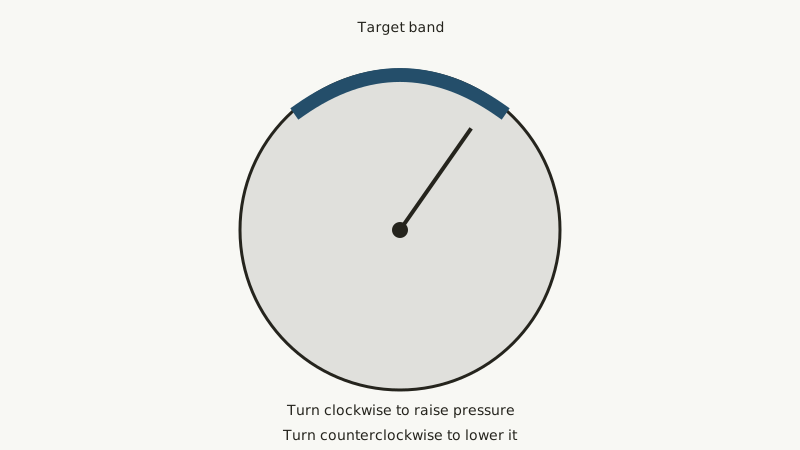
The order that avoids mistakes:
- Close all fixtures and note the starting number.
- Loosen the locknut, not the whole valve.
- Give the screw a single small turn, then run and shut a tap so the spring reacts.
- Read the gauge again. Repeat until it sits in the 50s psi.
- Tighten the locknut and run a flushing toilet and a shower to feel the change.
Never remove the cap or the bell while the line is pressurized. If the screw spins freely with no change, or pressure climbs by itself overnight, the valve has failed and adjustment will not help.
How can I tell a regulator is failing?
Clues pile up: knocking inside the walls whenever a tap snaps shut, a whine or hiss, pressure that jumps or drifts upward overnight, a dial that ignores the adjusting screw, and drips at hoses or fittings that used to be dry. A tap that spits while another runs feebly can mean a worn diaphragm.
The overnight test is the most useful. Read the gauge at night, leave it connected, and read it again early in the morning. If it has climbed by 10 psi or more with no water used, the regulator is passing pressure it should hold back.
Do not confuse this with water hammer, which can also bang pipes. Regulators and hammer arrestors work together, and a failed valve often brings both symptoms at once.
How long does a pressure regulator last, and what does replacing it involve?
Consumer plumbing guides often quote a decade to fifteen years, and the number shrinks with silt, mineral-heavy water and constant strain. Swapping one is routine plumbing: shut the supply, empty the pipe, bolt in the new body and confirm the setting on a gauge. Published cost guides show a few hundred dollars for the job, and our regulator pricing page has more.
A handy owner can attempt it, but the City of Long Beach requires a plumbing permit for installations and alterations, with a short list of exemptions. Owner-occupants who do their own work may apply for one themselves. Anyone else hires a contractor who holds a California contractor license, and the written quote should say who applies for the permit.
A new valve can also close off the plumbing so that heated water has nowhere to expand, which is why a water heater may then need help. Many plumbers add a small expansion tank at the same time, so mention it when you ask for quotes. The page on replacing a regulator covers parts and sizing.
Common questions
Is swapping the valve a job for a homeowner?
Sometimes. That means closing the supply, working with compression or push fittings and testing every joint. The catches are the permit and a possible expansion tank. One slip can flood a room or leave water pressure unsafe at the taps. Unsure about any step? A plumber usually needs about an hour.
How do I know the regulator is bad rather than the street supply?
Compare the gauge on the hose bib at night with the reading next morning. Climbing numbers with a regulator installed point at the valve. If the gauge is low even with the valve wide open, look for clogs and closed shutoffs instead.
What is a regulator for a pump, a showerhead or a garden hose?
A garden hose regulator is a small inline fitting that screws onto the spigot to protect hoses and sprinklers. A showerhead insert limits flow, not whole-house pressure. A well pump uses a pressure switch and tank. None of those adjusts the pressure inside the house the way the main regulator does.
Does Long Beach have high water pressure?
No single answer fits the whole city. Street pressure depends on the water system serving you and the slope of the ground, so a low-lying lot often sees more than a house up the slope. Thread a gauge onto the spigot and judge from that reading.
For the wider picture, start with Harbor Lights Plumbing.
References
- U.S. EPA WaterSense, Fix a Leak Week
- City of Long Beach, plumbing permit requirements
- California Contractors State License Board, hiring a contractor
- Plumbinguide, water pressure regulator replacement cost
- Published California plumbing code summaries on the 80 psi rule, checked November 2026
Updated