How do you stop water leaking from a plastic pipe right now?
Find the valve nearest the leak, or throw the main if the house has no branch valves, and let the lowest tap run dry. Dry the surface. Then either pull silicone bonding tape tight across the damage or strap a rubber sleeve over it with clamps. Restore water slowly. For a hairline split, that patch might last a weekend, no longer.
Rather not do it yourself? The Harbor Lights home page lays out the process, and the quote form takes your details. The plastics in question are PVC, CPVC, PEX and polybutylene, which run through most Long Beach homes built or re-piped since the 1960s.
Joints and fittings fail far more often than straight runs of plastic pipe, and wrapping tape around a cracked fitting under load only delays the next drip. Think of the wrap as a bridge to morning, nothing more. Water showing in a ceiling or wall means the main goes off first. After that, burst pipe warning signs help you judge how bad it is.
What is a temporary fix for a busted pipe?
Stop the supply, empty the line, wipe the split dry and cover it. Fast options are silicone self-bonding tape stretched hard over the crack, a rubber sleeve pinched by two stainless clamps, or a push-fit repair coupling. Respect whatever bonding time the packaging lists, then bring pressure up in stages while you watch the patch for about ten minutes.
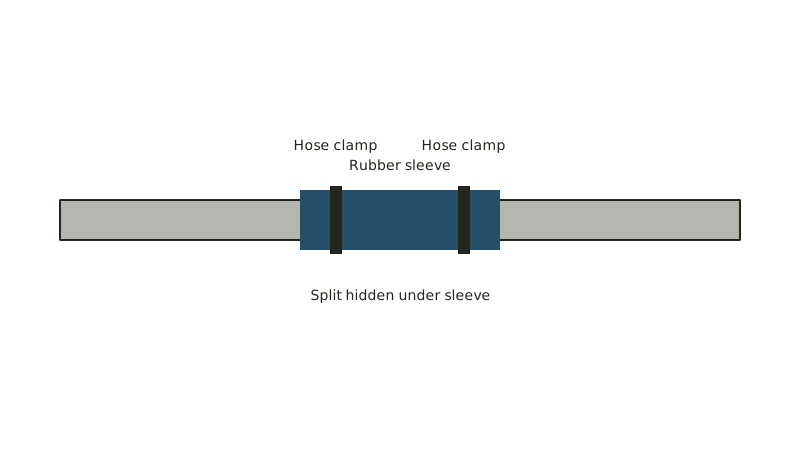
The rubber-sleeve version goes like this:
- Cut rubber a few inches longer than the split, from an old bike tube or a garden hose slit lengthwise.
- Wrap it so it covers the damage and extends past it on both sides.
- Set a hose clamp near each end, tightening until the rubber bulges slightly, not until the pipe deforms.
- Open the valve a little and watch for beads of water.
Epoxy putty can plug a small hole in a dry pipe and sets within minutes, but it performs badly on threaded joints that weep. For anything beyond a patch, see our write-up on water pipe leak sealant.
Can I build a pipe clamp at home?
A DIY clamp needs three parts: a soft pad, a stiff backing and a band that squeezes the two together. Cut the pad from rubber, lay sheet metal or a split length of pipe on top, and cinch both with two worm-drive clamps. At ordinary household pressure it can hold a pinhole or hairline crack.
File any sharp edge off the backing so it cannot score the plastic, and tighten gradually, because thin-wall CPVC splits when crushed. A store-bought repair clamp sized to the pipe costs little next to a second leak. Skip clamps on threaded joints. If two attempts fail to stop the drip, close the valve and quit experimenting.
What if a pipe clamp keeps leaking, or you need it off?
A clamp that still drips usually sits off-center. Empty the line, loosen the screw, nudge the rubber so it covers the damage squarely, then tighten evenly. Replace the pad if it looks flattened or cracked. To remove one, close the supply, open a faucet to bleed pressure, back out the screw and peel the pad away slowly, since it can stick to the pipe.
If you keep having to snug a clamp, the pipe wall is giving up. Stop cranking and plan a cut-out repair, which swaps the damaged stretch for new pipe and couplings.
How do you stop water leaking from plastic pipe outside?
Close the supply feeding the outdoor line, let it empty, dry the spot, and repair with a cut-out and coupling rather than tape. Sun makes plastic brittle. Chalky or crazed PVC and PEX should come out, and its replacement belongs underground or behind a shield.
Strong sun and coastal air are hard on exposed plastic, and irrigation lines around Belmont Shore and Naples tend to crack at the surface long before buried sections do. Clues are soggy soil, a sprinkler zone that never reaches full spray, or one lawn patch that stays swampy. Dig only after calling 811, and leave anything near gas or electrical conduit to pros.
What stops a dripping tap?
Turn the little stop valve below the sink instead of the main, then swap the worn part. Water from the spout generally points to a tired cartridge, washer or O-ring, while seepage at the handle or base suggests a loose packing nut or dried-out seal. A cartridge change can take half an hour with a screwdriver and hex key.
Carry the worn part to the hardware store for an exact match. A stuck handle, a pitted seat or a decades-old faucet makes a new fixture the smarter spend. Step-by-step help for each design is in our leaky faucet guide. EPA says the average household loses over 9,300 gallons yearly, and the slow tap drip is one contributor.
What causes pipe leakage?
Typical culprits are poorly glued or loose joints, high pressure, aged pipe, sun exposure, movement and chemical attack. Physical damage counts as well, whether a nail through a wall, a shovel in the yard, or a run left unsupported until it sags and strains a fitting.
Pressure is quietly destructive. Above 80 psi of static pressure, the California Plumbing Code wants a regulator, and lines held at 100 psi age fast. A cheap pressure gauge threads onto a hose spigot. Polybutylene, found in some houses of the late 1970s to mid 1990s era, can break down from within, which is why whole-house replacement is common. Earthquake shifting stresses joints as well. For more, read what makes a pipe burst.
Who is responsible for the water pipe into the house?
Within Long Beach, the water department's responsibility stops at the meter, which makes the line from there into the house generally the owner's. The utility holds on to the street main plus the meter. Other cities can draw the line at the curb or property edge, so ask your own supplier where it falls.
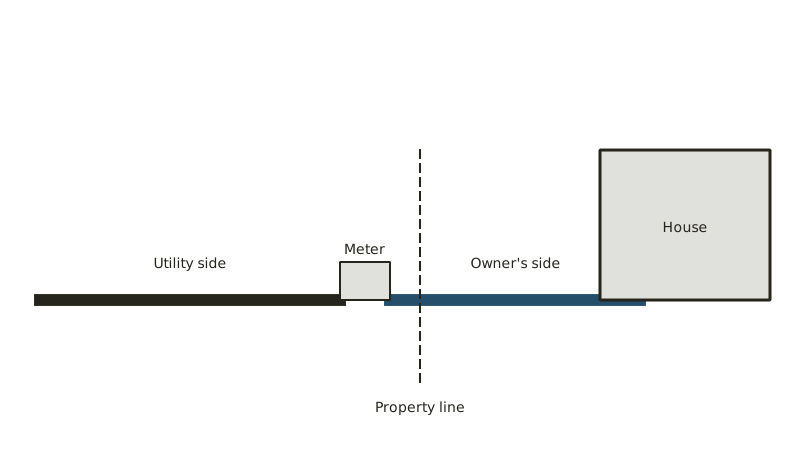
Long Beach Utilities writes this into its rules and regulations, treating the connection and meter as its property and its duty as ending there. Water pooling before the meter is a call to the utility. Wetness past it is for a local plumber, and a buried run can leak for weeks unseen. Watch for a bill that leaps without explanation, or a dial that turns with every tap shut. See high water bill causes.
Will homeowners insurance cover a broken water pipe?
Typically a policy pays for the water damage after a sudden burst, yet not the failed pipe, and it tends to exclude slow leaks that ran unnoticed for weeks or months. Wording differs between policies, so read yours. Ring the insurer early, ahead of repairs, so someone can see the damage.
Stop the flow, photograph everything with dates, keep ruined items, and ask the plumber to write down what failed and when. That note is your best evidence for a sudden event. A denial you believe is wrong can be taken to the California Department of Insurance, which accepts complaints. Details sit in burst pipe and insurance.
When should old house water pipes be replaced?
Not on a calendar: the material decides. Copper often serves for decades, galvanized steel gives out sooner, and polybutylene is usually pulled out given its record. PEX and CPVC are newer with a shorter track record, though rated for decades of ordinary service. Water chemistry, pressure and workmanship all shift the number.
Homes of the 1920s to 1950s vintage, the kind found in Belmont Shore, Bixby Knolls and Naples, may still carry galvanized steel with copper patches added over time. Two leaks in a year, brown water, sagging pressure or green crust at fittings all argue for replacing rather than patching. Pricing is per house, so read about repiping a house and compare quotes.
How do you spot a dodgy plumber?
Red flags: someone wants most of the money in advance, nothing is written down, a firm price arrives by phone for a job nobody has looked at, or you are rushed to sign. From $1,000 of work, California wants a contractor holding a license on the job, and a written contract starts at $500, with deposits held to the lesser of $1,000 or ten percent.
Any license number can be searched on the state contractor board's website before work begins. Be cautious as well about unannounced door knockers after a storm, a price that doubles once the wall is open, and any refusal to write the scope down.
How do you pick a reliable plumber and avoid overpaying?
Ask for a license number, look it up online, get the scope in writing, collect two quotes at least and ask what each omits, such as permits or wall repair. Overcharging looks like a number far from the others, a trip fee nobody explains or a vague line reading "misc. materials."
A fair estimate reads simply: the failure, the fix, the price and the exclusions. Service call, hourly and parts rates are laid out in plumber costs around Long Beach. When a figure looks off, ask for hours and a parts list. We arrange local plumbers around Long Beach, Signal Hill, Lakewood, San Pedro, Wilmington and Seal Beach, and every job starts with a written quote. Neighborhoods are listed under areas we cover.
How do you find the best plumbing company for your job?
Fit the company to the job. Water behind a wall calls for leak detection equipment, gas piping calls for someone who works on gas, and an old-house repipe calls for a contractor who pulls permits. Compare license classification, relevant local work and how plainly the estimate explains scope. Reviews help, but a written scope helps more.
The calm time to shop is before something breaks. Jot down a short list and walk the house to find the water main and the gas valve, which are separate. Long Beach and Signal Hill gas comes from the city's own Long Beach Energy Resources: on a gas smell, walk out, then call 911 or (562) 570-2140 from a safe distance. Homes in nearby cities served by SoCalGas use 1-800-427-2200. Keep a flashlight and wrench beside the gas valve.
Common questions
What keeps pipes from bursting?
Hold pressure at or below 80 psi with a regulator, replace brittle or corroded runs before they split, and locate the main shutoff ahead of any emergency. Freezing is rare along the coast, so pressure, age and joint failure matter more than ice. A checklist lives in burst pipe prevention.
What marks out a good plumber?
Good ones hand over a license number that checks out, a written scope and price, and a plain account of the cause. They explain which permit applies, stay in proportion to the problem and return the old part when asked.
How can you tell a quote is padded?
Set the line items beside two other quotes. A big gap, fuzzy labor, a steep trip fee or an unexplained materials charge are the tells, so ask for hours and parts on paper. Typical hourly and call-out rates are in the plumber cost guide.
Is a leak outside the house a water department problem?
Only if it sits upstream of the meter, on the street side. Beyond that point, a Long Beach leak is generally the owner's to fix. Long Beach Utilities takes water and sewer emergencies in the street at (562) 570-2390, and a local plumber handles the pipe on your side.
Will tape or epoxy hold a leaking joint?
Both can slow a small leak on dry pipe, though neither lasts on a pressurized joint. The white PTFE thread tape only seals threads and does nothing for a crack. Replace the damaged section outright, or ask a local plumber to.
References
Updated