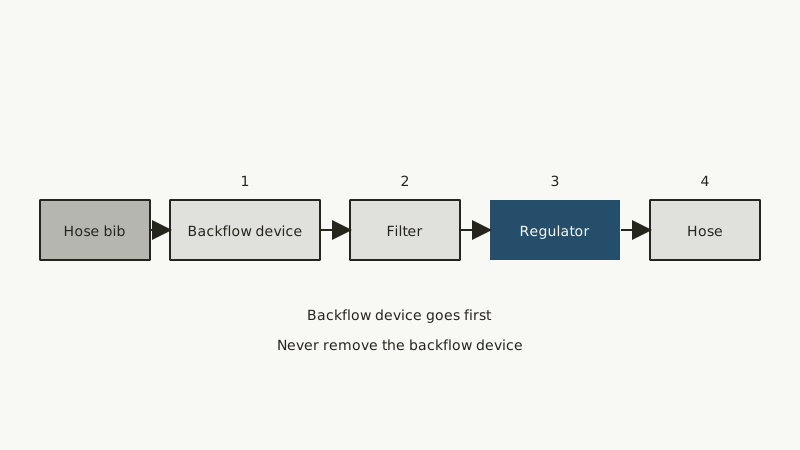
A regulator screwed onto a hose bib trims the pressure that reaches a drip system, soaker or sprinkler so fittings stay on and emitters stop spraying. It cannot cure a house whose pressure runs high in every room. Measure first with a gauge. A high number points to a valve at the main instead, which our water pressure help page explains alongside low-pressure causes.
What does a garden hose pressure regulator do?
It holds the water leaving the hose bib at a lower, steady pressure, commonly preset to about 25 psi for drip irrigation. Drip tubing and emitters are built for roughly 15 to 30 psi, and anything above that can push fittings off the tubing, eject emitters and wear the system out early.
Hose-end regulators come in two styles. One has a fixed setting, such as 25 psi, which suits most drip lines. The other has a dial or screw to choose a pressure, and is aimed at other tools and sprayers. Both sit between the faucet and the hose or tubing.
Manufacturer guidance, such as that from a major drip irrigation maker, says to use the regulator only when the supply pressure runs above the system's rating, and notes that many homes sit somewhere between 40 and 100 psi at the tap. So a regulator is often needed, not an extra.
How do you check whether the pressure is actually too high?
Screw a gauge to an outside hose bib, make sure no other fixture is running, open the bib all the way and read the needle. The state plumbing code treats readings beyond 80 psi as excessive, and anything above your drip system's rating is too much for that system. Test early in the morning, when use in the neighborhood is low.
Interpreting the number:
- Below about 30 psi. No regulator needed for drip, and you may have a low-pressure problem instead.
- Around 40 to 60 psi. Normal for a house, and drip still wants a regulator.
- Above 80 psi. Too high for the house plumbing too. A whole-house pressure regulator is the right fix.
A gauge is a cheap hardware aisle item. If pressure seems to swing through the day, record an early reading and an evening one.
In what order should the parts go on the hose bib?
Backflow device first, then a filter if the water carries grit, then the regulator, then the hose or drip adapter. If you use a battery timer, it goes upstream of the backflow device. This order follows a manufacturer's installation sequence for hose-thread setups and keeps debris from jamming the regulator.
Long Beach adds a rule of its own: hose bibs and laundry sink faucets must have a non-removable backflow prevention device. Most new bibs have a built-in vacuum breaker, and a screw-on one covers older bibs. That device keeps lawn water, fertilizer and soap from siphoning back into your drinking water. Never remove it to fit a regulator.
Some practical tips:
- Add a screen filter of about 150 mesh if your supply carries sediment.
- Hand-tighten fittings and use a fresh washer in each hose thread.
- Where you run several zones with valves, the regulator normally goes downstream of each valve.
- If the bib handle itself drips, fix that first. The leaky faucet guide covers it.
Why does a hose regulator not help if the whole house is high?
Because it only protects what sits after it. Washer hoses, toilet fill valves, ice makers, the water heater and faucet cartridges indoors still take full force and wear out sooner. A high gauge reading usually calls for a pressure-reducing valve on the main line, often set in the neighborhood of 50 to 70 psi.
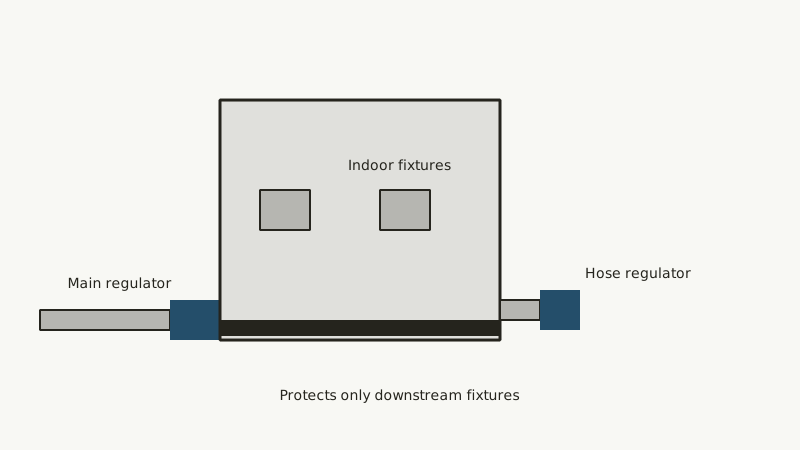
High house pressure shows up as knocking pipes, a relief valve that will not stop weeping, fixtures that spit or fail early, and hose connections that burst. Where a regulator is already installed at the main and pressure is still high, the regulator may have failed. Our guide to where the regulator is located shows how to find it, and the adjusting a regulator valve guide covers the controls.
A whole-house regulator also creates a closed system, so a water heater expansion tank may become necessary. See the expansion tank article for that consequence.
What does it cost, and who should install it?
A hose-end regulator is an inexpensive part from a hardware or garden store that threads on in about a minute. A whole-house valve is a plumber's job, with pricing on the regulator installation cost page and replacement steps in the regulator replacement guide.
Whole-house work means cutting into the main line, which belongs to a plumbing contractor holding a California license. Long Beach requires a plumbing permit for installing or altering piping and water treatment equipment, with repairs of faucets and similar items exempt, so ask the plumber who applies for the permit.
To have a visit arranged for a pressure test and a valve, start with the quote form, and browse other services from the Harbor Lights Plumbing home page.
Common questions
Do I need a regulator for a soaker hose or drip system?
Usually yes, when your supply pressure is above what the system is rated for. Drip lines work best around 15 to 30 psi, and house pressure in many homes runs well above that. A 25 psi regulator at the bib protects tubing and emitters. If your pressure is already low, you do not need one.
Where should the regulator go, at the faucet or along the hose?
At the faucet end, after the backflow device and any filter, so it protects the entire line. Putting it far along the hose leaves the first stretch under full pressure and can burst fittings. Long Beach requires the backflow device on the bib, so do not skip it.
Can a garden hose regulator damage my water pressure at home?
No. It trims pressure only beyond the bib, so indoors nothing changes. Weak flow in the house comes from somewhere else, for instance a clogged aerator, a failing whole-house valve or a supply issue, and a plumber can test the line.
Is high water pressure bad for my plumbing?
Yes. The plumbing code calls pressure above 80 psi excessive because it strains valves, supply hoses, fixtures and the heater. If your gauge shows a high reading, ask a plumber about a regulator at the main, and keep any relief valve intact.
References
Updated