Weak pressure is fixable more often than people expect, and most of the fixes cost little. Work in this order: confirm the problem with a gauge, check the main valve, clean fixtures, look at filters and the regulator, and only then think about a pump. Each step crosses a suspect off. Should the list run out with no answer, the low water pressure service page describes what a plumber tries next.
What can I check in the first fifteen minutes, for free?
Compare taps: is it every fixture or one? Then open the main shutoff fully, because a valve left partly closed after earlier work is a classic cause. Then attach a gauge to a garden spigot, close the indoor taps, and read the dial. Between them, these three checks sort most cases into whole-house, single-fixture or hot-side-only.
Hardware stores sell gauges cheaply, and nothing else here is as useful. A reading in the 40s to 60s psi clears the supply and puts the restriction beyond the spigot. A low reading sends you toward the main and the regulator. Strong cold with feeble hot means looking at the heater's shutoff or its connecting lines. Our page on sudden pressure loss adds a few checks for abrupt changes.
What does Long Beach consider normal pressure?
Long Beach Utilities' rules say pressures are expected to run from 35 to 70 psi in normal operation. Under 15 psi, the customer is the one who has to supply on-site pumping. Over 80 psi, a city-approved regulator and strainer become the customer's obligation. The department adds that it promises no specific pressure, so 40 psi on your gauge is normal, not a defect.
That tells you where the line is. A 45 psi reading with a disappointing shower means the city is not at fault and the cure lies inside your walls. A reading under 30, or the same complaint from the neighbors, justifies a call to the utility's emergency number, (562) 570-2390, or its main line, (562) 570-2300. San Pedro and Wilmington are supplied by LADWP, which has its own rules. The state code sets 80 psi static as the point where a regulator is mandatory.
Which fixtures and filters usually turn out to be the culprit?
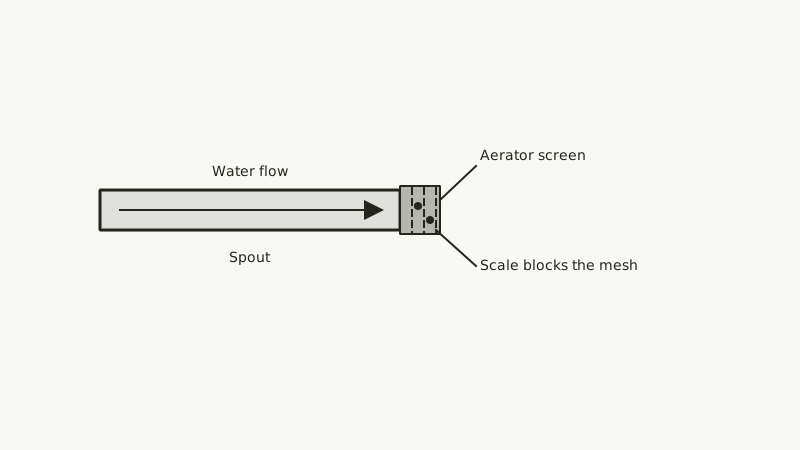
Aerators and showerheads clog with mineral scale, and Long Beach has moderately to very hard water: its 2025 report lists zone averages of about 4.4 and about 12.8 grains per gallon. Twist off the aerator, leave it in vinegar, rinse the mesh, and treat the showerhead the same way. Whole-house filters and softeners can also clog, so try running water on their bypass.
A clogged cartridge is a quick swap. For showerheads, the EPA's WaterSense label means 2.0 gallons per minute or less, with performance criteria for spray force; if the old head is a plain scaled one, replacing it may be the cheapest fix. Our guide to the best showerheads for low pressure and the page on weak shower pressure cover choices in more detail.
Might the regulator or hidden pipe damage be behind it?
Yes, and these causes belong to a plumber. A failing regulator may hold pressure too low, galvanized steel can rust shut from the inside, a leak can bleed off flow, and a partly open or worn valve can throttle the supply. The signs are a low or jumpy gauge, rusty water, a meter that moves with taps closed, and slow decline over years.
Older bungalows near Belmont Shore, Bixby Knolls and Naples are the likeliest to have galvanized lines, and the fix is replacement piping, not a tweak. A regulator swap is a defined job, described in replacing a pressure regulator. If you suspect a leak, close all taps and watch the meter for two hours. Those are the stop signs: from here on, the work involves permits, pipe and the main.
Will a booster pump raise the pressure, and is one allowed here?
A booster pump helps when the street supply is steady yet too low for your needs, such as an upstairs bath on a house that sits at the tail of a supply line. It adds pressure but cannot create flow the main does not deliver. Before buying, confirm the cause with a gauge, check Long Beach's rules, and have a plumber size and install it.
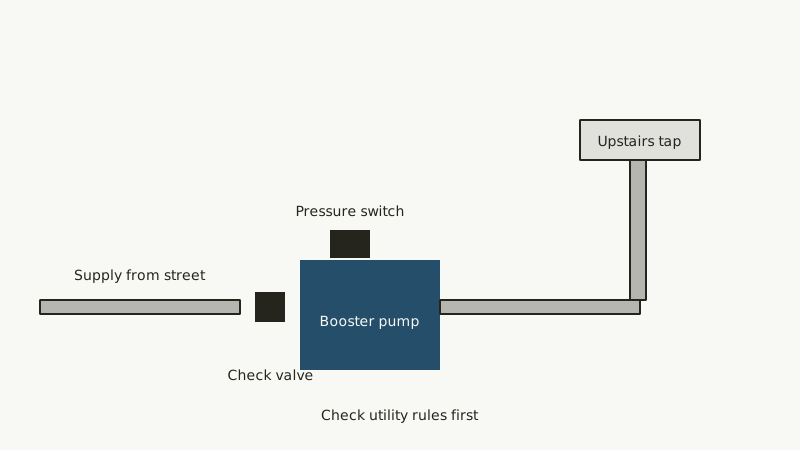
The utility's rules say the customer provides on-site pumping when pressure falls under 15 psi, so a pump is an anticipated remedy, but a pump connected to the city supply also raises backflow questions. The utility's backflow section lists buildings with house pumps and storage tanks among facilities that need a double check assembly, and that list is written with commercial buildings in mind, so ask Long Beach Utilities at (562) 570-2300 how it applies to a home. A permit is also likely.
Pumps add noise, electricity use and a failure point, and a pump that raises pressure past 80 psi trips the regulator rule. A plumber can choose a size that matches the flow you need and fit a pressure tank so the pump does not cycle constantly. Raising pressure also strains old pipes and the water heater, which is another reason to find the real cause first.
What if only the upstairs or one corner of the house is weak?
Height costs pressure. Fresh water loses about 0.433 psi for every foot of rise, according to USGS material, so a tap 10 feet above the gauge gets roughly 4 psi less. On a hill, as in parts of San Pedro, the effect grows. If the downstairs gauge reads fine and the upstairs is weak, the answer may be pipe size, a restriction on that branch, or elevation.
Sometimes a branch line is partly blocked by scale or a stuck valve, or the pipe is simply undersized for the fixtures it serves. A plumber can test pressure at the weak branch and compare it with the main. Where the house reads low everywhere, our page on why pressure drops lists the causes behind it.
At what point does DIY end, and what does professional help run?
Your limit is the main, the regulator, pipe behind walls and anything that calls for a permit. The contractor licensing rule applies to jobs of a thousand dollars or more, labor and materials together, and Long Beach wants a plumbing permit before fixtures and equipment are installed or replaced, excusing repairs that use no new materials. Aerators, filters and showerheads are fair game.
For cost, a regulator replacement runs roughly $200 to $700 nationally per Angi's 2026 data, and the details are on the regulator installation cost page. Piping or pump work costs more and hinges on the quote. To have someone take a look, put in a request on the quote page. Our other trades are on the Harbor Lights home page.
Common questions
Is there a way to isolate the cause without a plumber?
Fit a gauge to the hose bib and compare its number with the 35 to 70 psi the city expects. Healthy means the trouble is farther along, in fixtures, filters or a branch. Low means the main, the regulator or the street. A meter that turns with taps closed means a leak. For a few dollars, the gauge settles most arguments.
Does turning the regulator screw raise pressure safely?
Within limits, yes. A clockwise turn of the adjusting screw raises pressure, though the state ceiling is 80 psi static and higher numbers strain pipes and the heater. Turn in small steps, watching the gauge as you go. A screw that changes nothing means the valve has failed. The routine is shown in the page on adjusting the regulator.
Why did pressure drop after the plumber or the city worked on the line?
Disturbed pipe can leave debris in aerators and screens, a valve not fully reopened, or air in the lines. Run the taps and clean the aerators first. A house that stays weak throughout needs a look at the main shutoff. If neighbors share the problem, the utility may still be restoring pressure, so call its water line.
Will a bigger pipe fix low pressure?
Sometimes. Where a long run or an undersized branch is the restriction, larger pipe helps, but pipe size cannot fix low street pressure. The gauge shows which case you have. Replacing old galvanized lines with new ones often improves flow as a side effect, because the rusted pipe has narrowed inside.
References
- Long Beach Utilities, Rules and Regulations 2024 (section 201, conditions of water service; section 802, backflow)
- USGS, hydrostatic gradient of fresh water, 0.433 psi per foot
- California Plumbing Code 608.2, excessive water pressure
- U.S. EPA WaterSense, showerheads
- Long Beach Utilities, 2025 water quality report
- City of Long Beach, plumbing permit requirements
- California Contractors State License Board
Updated