A tank-style water heater installed in a Long Beach house typically lands between about $1,000 and $2,500 all in, based on national price guides from Thumbtack's October 2026 update. Tankless units cost more once venting and gas or electrical upgrades are counted. The sections below split the bill into parts so you can see where a quote is high. The work behind these prices is described on our water heater page, and the Harbor Lights home page lists everything else.
Which costs less in the end, repairing the old heater or buying another?
Fixing it wins if a single part died and the tank is intact. For repairs, Thumbtack's October 2026 guide shows about $297 to $1,198 nationally, and a thermostat or element in the neighborhood of $150 to $200. Buying new wins once the tank itself weeps, because a leaking shell is seldom worth saving.
Age tips the scale. DOE's Energy Saver Guide gives storage models 10 to 15 years. Pay $200 for an element on a heater already past twelve and you are funding a machine that could quit next winter; spend the same on a six-year-old and it is an easy call. One provider in the same guide charged about $395 to clean and repair a thermocouple. The data plate carries the build date, and our page on the replacement interval for heaters shows where to find it.
How much should installation cost for different tank sizes?
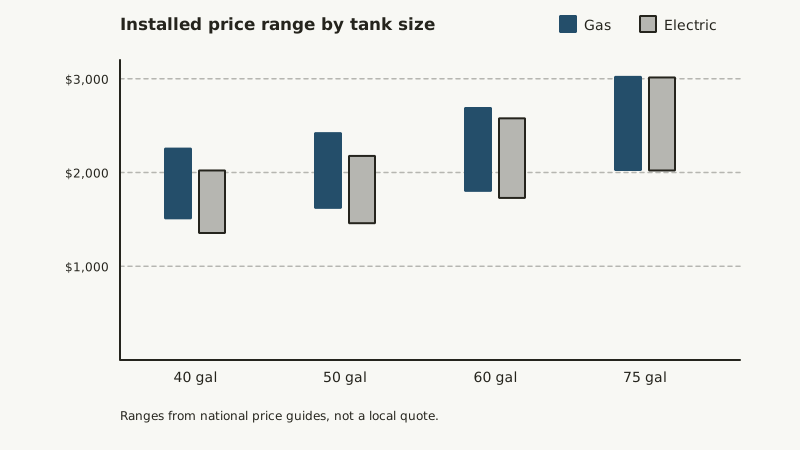
Capacity drives the price upward, and gas sits a little above electric. Using Xactware numbers that fold in labor and materials, Thumbtack lists a 40-gallon gas unit at $1,511 to $2,255 and an electric one at $1,355 to $2,022. At 50 gallons the spans are $1,623 to $2,420 for gas and $1,459 to $2,177 for electric.
| Tank size | Gas, installed | Electric, installed |
|---|---|---|
| 40 gallon | $1,511 to $2,255 | $1,355 to $2,022 |
| 50 gallon | $1,623 to $2,420 | $1,459 to $2,177 |
| 60 gallon | $1,804 to $2,688 | $1,729 to $2,578 |
| 75 gallon | $2,027 to $3,020 | $2,022 to $3,014 |
Overall averages in that guide are $1,239 to $1,353 for gas and $1,080 to $1,088 for electric, and the extremes across every type stretch from $351 to $4,479. Nothing sourced covers a 30-gallon heater, so a smaller tank should come in beneath the 40-gallon row, but get the actual number on paper.
Which charges besides the heater itself should I expect?
A straightforward swap takes two to three hours, according to the guide, and more when the heater sits in a cramped closet or crawlspace. No hourly labor rate is published there. The add-ons are easier to tally: about $100 to carry off the old tank, and $50 to $200 for permits.
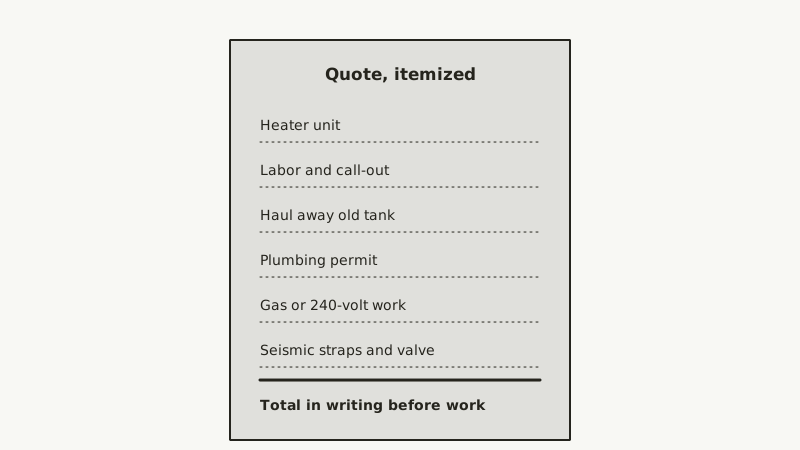
Electric units often need a 240-volt circuit, and gas units need a gas line and proper venting, so a swap between fuel types costs much more than like for like. In Long Beach, the city says a plumbing permit applies whenever water heating equipment is installed, altered or replaced, so look for a permit and inspection line in your quote rather than meeting it later. Section 19211 of the California Health and Safety Code adds an earthquake rule: new and replacement heaters must be braced, which explains the strapping kit on many invoices. Two more entries worth finding: the relief valve (swapping it) and a thermal expansion tank (swapping that).
What will a tankless installation add up to?
For a tankless installation, leaving out the unit, Thumbtack's national average is $747 to $2,312, within an observed spread of $282 to $5,327. Sorted by flow, labor plus materials come to about $1,416 to $2,114 at 3 to 3.9 gallons a minute and $1,655 to $2,470 at 5 to 5.9.
The unit comes on top. Electric tankless installs cheaper but may call for a service upgrade. Gas ones cost more at the start and could require a fatter gas line plus proper venting. DOE credits tankless heaters with over two decades, versus 10 to 15 years for tanks, which is the argument for paying extra. More on the trade-off in tankless installation prices and in tank versus tankless.
Why do water heaters give up in the first place?
Gas models tend to lose a thermocouple or collect grime around the pilot. Electric ones lose an element or thermostat. Sediment, an anode rod that has been eaten away and a leaking tank round out the list. One manufacturer's maintenance guide (A. O. Smith) says look at the anode every three years at minimum, and yearly with a softener.
Local water is part of it. Long Beach Utilities reports hardness averaging about 76 ppm in the blended zone and 220 ppm in the other, so mineral buildup is likelier in the harder zone. Flushing the tank, per the same A. O. Smith guide, matters most for gas heaters. A popped relief valve usually means high pressure or thermal expansion. Part-level detail is in the write-ups on the thermocouple, the anode rod and the heating element.
The heater quit tonight. What now?
A same-day swap can happen, though rush work generally costs extra and nights or weekends often run well above daytime pricing. Close the cold supply, cut the power or gas feeding the heater, and if it is leaking, drain it through a hose. Then ask for a visit and have the total put on paper.
Our desk is open Monday through Friday only, so on a Saturday the supply and fuel shutoffs are yours to close, and any homeowner can. Smell gas? Leave the pilot alone, go outdoors and phone the utility. Long Beach and Signal Hill customers reach Long Beach Energy Resources on (562) 570-2140; SoCalGas serves the cities around them, at 1-800-427-2200. Rush work gets its own page, emergency water heater repair. Doing a furnace in that same visit? Request each appliance on a separate line.
Common questions
Which part of a tank heater fails first?
Thermocouples and fouled pilots top the gas list; elements and thermostats top the electric one. Corrosion kills the tank itself once its anode rod is gone, and a rusted or dripping shell cannot be patched. Lukewarm output usually points to sediment or a part on its way out.
Is a repair ever enough, or is a new heater always the answer?
Often a repair does the job, since thermostats, elements, thermocouples, valves and anode rods are all replaceable. A dripping tank is the exception and generally ends in a new heater. Thumbtack puts a thermostat or element at about $150 to $200, though an elderly unit may not merit even that.
What lifespan is reasonable for a storage tank?
Most storage heaters make it 10 to 15 years, by the Energy Department's count, and tankless units exceed 20. Hard water, neglect and a spent anode cut that short; flushing and a timely anode swap stretch it. The label carries a date code. Begin saving once the tank passes ten.
Which brand lasts longest?
None of the sources we checked rank brands by lifespan, so we will not name one. Compare warranty length, the tank's glass lining, the anode rod type and whether the installer will service it. Installation quality, water hardness and maintenance shape life more than the name on the tank.
References
- Thumbtack, water heater replacement cost (updated October 2026)
- Thumbtack, water heater repair cost (updated October 2026)
- Thumbtack, tankless water heater installation cost (updated October 2026)
- U.S. Department of Energy, Energy Saver Guide
- A. O. Smith, troubleshooting and maintenance guide
- City of Long Beach, plumbing permit requirements
- California Health and Safety Code section 19211, water heater bracing
- Long Beach Utilities, 2025 water quality report
Updated