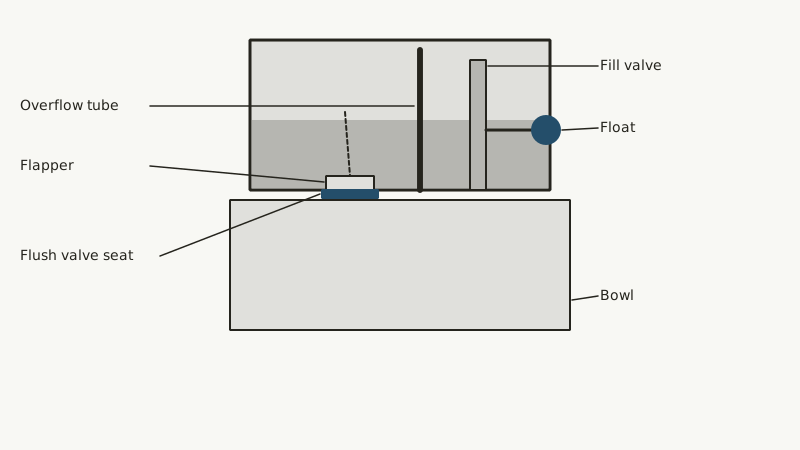
Almost every misbehaving toilet traces to one of four things: a perished flapper, a fill valve stuck half open, a wax seal that has collapsed under the bowl, or a stoppage beyond the trap. You can tell them apart in ten minutes with a flashlight and a square of dry tissue. When it needs a professional, use the quote page, and the price is fixed on paper first. Every fault has a section below, and the rest of our services are on the Harbor Lights home page.
Which toilet problem do I actually have?
Watch what the toilet does when nobody touches it. A tank that refills with no one near it has a flapper leaking down into the bowl. Water hissing after the flush stops points at the fill valve. A damp floor around the base suggests the seal under the bowl. A weak, sluggish flush with gurgling elsewhere hints at a blockage past the trap.
Dye settles doubts. Stir a little dye into the tank, walk away, and look in the bowl after ten minutes. If the color has crossed over, the flapper is the culprit. A clear bowl with a wet floor sends you to the supply line connection, the tank bolts and then the base. Longer pieces cover the first and last symptoms: a toilet that keeps cycling and a flush that has gone feeble.
What happens during a toilet repair visit?
The plumber shuts the supply at the stop valve, opens the tank, identifies the failed part, replaces it and runs several test flushes. Typical work includes swapping a flapper or fill valve, resetting the float, adjusting a chain, tightening or replacing tank bolts, and pulling the bowl to renew a wax ring and check the flange beneath.
Bigger finds change the plan. A rusted-through flange, soft subfloor next to the base or a crazed line in the china get reported first, since no seal survives on top of them. A cracked bowl or tank means replacement, never filler. Part-by-part detail lives in our write-ups on flapper repair, fill valve repair and the overflow tube.
How big is the bill for a toilet repair?
Thumbtack's October 2026 guide puts a typical toilet repair at about $149 to $355, with most people paying around $230. Simple repairs run about $100 to $250, while stubborn blockages can reach $400. The parts, flapper or fill valve or wax ring, run about $5 to $20 each.
Labor and the callout decide the rest. One example in that guide combines a $92 trip fee with $92 an hour, and hourly rates across plumbers are quoted from $45 to $150, with weekend or emergency service running roughly double. Water that has soaked drywall or flooring pushes the total up. These are nationwide yardsticks, so rely on the quote you get locally. Swapping out the entire fixture is priced differently; the numbers are in our toilet replacement cost page.
Can I fix a toilet myself, and where should I stop?
Yes, for the cheap, visible parts. A flapper, a chain, a fill valve and a flush handle suit a patient homeowner, since the small stop on the supply line cuts the toilet off from the rest of the plumbing. Stop when the problem is the bowl seal, a stuck stop valve, a cracked fixture or anything involving a drain line.
Two Long Beach details matter. The city's plumbing rules say a permit applies when a fixture is installed, altered or replaced, with a narrow exception for stopping leaks without new materials, so ask the plumber or the Building and Safety counter how a full toilet swap is handled. And the local supply is not soft: Long Beach Utilities reports hardness averaging about 76 ppm in the blended zone and 220 ppm in the MWD zone, so mineral crust on rim jets and fill valve seats is a common reason a toilet loses power or never quite shuts off. A flush lever that wobbles has its own page, loose handle that will not flush, and so does a loose seat.
Is the toilet worn out, or only a part inside it?
Usually just a part. Vitreous china itself can serve for decades, and the working innards are the cheap, replaceable bit. EPA's advice is a new flapper at least once every five years. Replacement of the whole toilet makes sense after cracks, repeated base leaks, rust-stained rot at the floor, or when an old high-volume model is wasting water.
Older Long Beach homes make this call interesting. A 1930s bungalow in Belmont Shore may still hold a tank that pre-dates modern flush standards. The EPA says inefficient old toilets can use as much as 6 gallons per flush, against 1.6 gallons for today's federal standard and 1.28 or less for WaterSense models, which it says can trim toilet water use by 20 to 60 percent. That can justify replacement even when the old one works. Long Beach Utilities lists rebates on its incentives page, so check eligibility before you buy.
Why is water gathering around the base of my toilet?
Usually the wax ring has given up or a bowl bolt has loosened, so each flush pushes a little water onto the floor. Alternatives include a dripping supply line, a weeping tank-to-bowl gasket, or plain sweating on a chilly tank. Dry the floor, then test each suspect one after another.
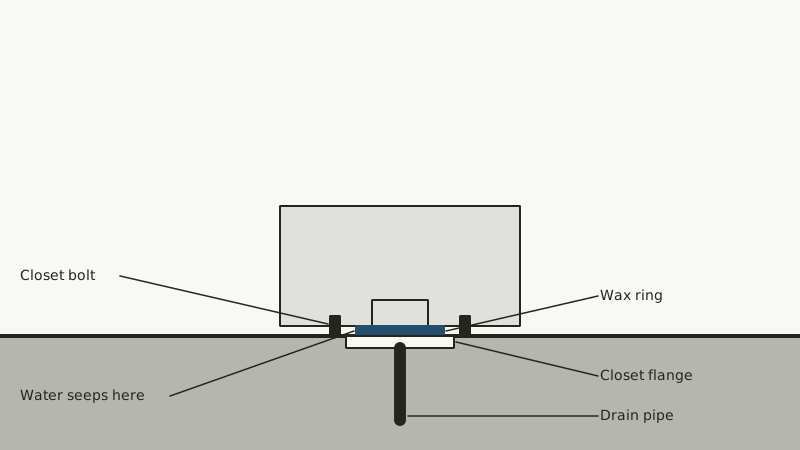
Watch the floor for about an hour with a dry tissue held against every joint. A damp supply fitting needs a snugger nut or a fresh braided hose. Beads under the tank blame the gasket or a bolt washer. Wetness only at the base, right after flushing, blames the seal. Do not keep flushing a base leak, since the water saturates the subfloor and can rot it. Rocking the bowl also tells you the closet bolts have loosened. How that repair goes is laid out in our toilet leak repair page.
Can a handyman fix my toilet cheaply?
For a flapper swap, probably. Still, California draws a dollar line at $1,000 of work including parts, and past that a contractor license is required; most toilet repairs sit well under. Whoever you pick, look the name up on the state license board's search page and get the price on paper.
A bowl pulled and reset needs a clean flange, a new seal and a level seat on the floor, and shortcuts there come back as stains in the ceiling below. For an apartment above another unit that matters twice as much. A plumber's visit includes testing the shutoff valve you will rely on the next time something goes wrong, and the guide to the toilet shutoff valve shows why that small part deserves attention.
Common questions
What should a leaking toilet repair cost me?
Thumbtack's October 2026 figures suggest about $100 to $250 for a simple leak repair, with the overall repair range running $149 to $355. A leak that has soaked flooring or drywall adds the cost of that repair on top. A wax ring swap is mostly time, because the part itself costs a few dollars. Your written local quote settles it.
What makes water escape from beneath the bowl?
Three usual suspects: the seal under the bowl, loose or rusted closet bolts and a broken flange. Now and then a thin split in the china, or a drip from the tank joint that trickles down the outside, imitates a base leak. Dye plus a dry tissue at every joint sorts it out.
Will tightening the bolts stop a base leak?
Sometimes, if the bowl has merely shifted. Turn each bolt a little, switching sides, as heavy force can crack the china. If water still creeps out, the seal is dead or the flange is damaged, and the bowl must be lifted off. Caulk alone will not hold back a failed seal.
Is it worth fixing an old toilet, or should I replace it?
Repair it when a cheap inner part is at fault and the china is sound. Replace it after cracks, repeat leaks, or if it is an old guzzler. Per EPA, WaterSense labels go to models using 1.28 gallons or under each time. Compare the quoted repair against a new unit and installation, which Thumbtack puts at about $199 to $418 for labor and related charges.
Do stores that sell toilets install them for the price on the shelf?
Rarely. Retail installation is often billed on its own line, and hauling away the old unit, a supply hose, a seal or valve work may come extra. Get each item written down before agreeing, then set that against the fixed quote from a plumber after a visit.
More in this guide
- Loose toilet seat repair
A toilet seat that slides or wobbles usually needs snugger bolts, new hardware or a hinge adjustment.
- Toilet leaks
Water around the base, a dripping tank or a silent leak into the bowl: how to find where a toilet leaks, what you can fix and when to call…
- Toilet fill valve repair
Replace a toilet fill valve in about half an hour: the parts, the steps, how to set the water level, the cost against a plumber, and what…
- Toilet repair
Repairing a toilet overflow tube: how to tell a cracked tube from a set-too-high fill, what a flush valve kit replaces, and when to call a…
- Flush valve repair without lifting the tank
Can a toilet flush valve be fixed with the tank still on?
- Toilet flapper repair
A leaky toilet flapper wastes water silently.
- Loose toilet handle
Flush handle floppy and nothing happens? Check the nut, the chain and the lever arm inside the tank.
- Toilet shut-off valve
A toilet shut-off valve that leaks, drips or will not turn: causes, what to do when it will not close, replacement steps, cost and the…
- Costs
What a plumber charges to replace a toilet in Long Beach: labor, the toilet itself, extras and what pushes the bill up, as a guide before…
- Toilets
A toilet that runs on, flushes weakly or has a stiff handle: which tank part is failing, what the fix costs, and when to call a toilet…
- Toilet keep running
A toilet that keeps running usually has a worn flapper, a stuck float or a misadjusted fill valve.
References
- Thumbtack, toilet repair cost guide (updated October 2026)
- Thumbtack, toilet installation cost guide (updated October 2026)
- U.S. EPA WaterSense, Fix a Leak Week
- U.S. EPA WaterSense, residential toilets
- Long Beach Utilities, water rebates and incentives
- Long Beach Utilities, 2025 water quality report
- City of Long Beach, plumbing permit requirements
- Korky, 2-inch flush valve repair kit
- California Contractors State License Board, license check
- California Business and Professions Code section 7048, contractor license threshold as amended in 2025
Updated