
A March 2026 price guide puts a whole-house replumb of a two or three bedroom home across a wide band, $4,000 at the bottom and $15,000 at the top, averaging about $8,000. Older houses crowd toward the upper half. Plaster walls, poor access and finish repairs all slow the crew. National numbers only go so far; what binds you is a quote from someone who has walked the house. Some other jobs we line up appear on the Harbor Lights home page, while the breakdown below shows where the money goes.
What do people pay to replace every pipe in a pre-1960 house?
One 2026 guide gives a standard two or three bedroom house an average near $8,000 inside a spread whose floor is $4,000 and ceiling $15,000. PEX typically runs $4,000-$10,000 and copper $6,000-$15,000 or more. A national average around $7,500 shows up in other guides we compared, a few with much wider outer limits. Crew time is the largest slice.
| House | PEX | Copper |
|---|---|---|
| 1 bath, under 1,200 sq ft | $2,500-$5,000 | $4,500-$8,000 |
| 2 baths, 1,200-1,800 sq ft | $4,000-$7,500 | $6,000-$11,000 |
| 3 baths, 1,800-2,500 sq ft | $6,000-$10,000 | $8,000-$15,000 |
| 4+ baths, over 2,500 sq ft | $8,000-$14,000 | $12,000-$20,000+ |
Each additional fixture connection adds $200 to $500, per the same guide. Use the table for budgeting, not as a price list. A Belmont Shore Craftsman with a kitchen at each end of the house will not match a Lakewood ranch of the same square footage.
What do old walls and old houses add that a new build would not?
Wall repair leads the list. Finish drywall, texture and paint are usually excluded from a repipe quote, and the guide budgets $1,000 to $3,000 for them. A two-bath house can need 10 to 20 access holes. Plaster over lath, typical before the 1950s, is often pricier to patch than drywall, so have that line quoted on its own.
Then the surprises. Old houses hide mixed materials, a former owner's patches, and lines that do not run where the plan says. Galvanized steel in the walls can be rusted shut at every fitting. Added up, a quote for an older house should include allowances for patching, plus a contingency for what turns up once walls are open.
If the house still has its first water service line, the utility can tell you what it is made of. The line running from meter to house is the owner's responsibility, which means an old lead or galvanized service line can become part of the project.
Which old pipes are actually worth replacing now?
Three kinds deserve attention. Galvanized steel, standard in homes from the 1930s into the early 1960s, corrodes from the inside after roughly 40 to 60 years and cannot be repaired, only replaced. Polybutylene, used from roughly 1978 through 1997, breaks down when exposed to chlorinated water. Lead, in pre-1930 homes, is a health issue.
Galvanized is the likely one in Long Beach bungalows near Belmont Shore, Bixby Knolls and Naples, and in older San Pedro houses. Rusty water, weak flow and recurring leaks are the symptoms, and the page on replacing galvanized pipe deals with them. Houses from the late 1970s and 1980s may have the other problem, and polybutylene replacement covers that. The guide prices replacing lead supply pipes in a pre-1930 house at $4,000 to $12,000.
On lead, the EPA says service lines turn up more often in older cities and in houses built before 1986, and that a lab test is the one sure check of your water. Ask the utility what material your service line is before assuming. Meanwhile the agency recommends cold tap water for drinking and cooking, because boiling leaves lead in.
Does it have to be all or nothing, or can I replace part of it?
The guide prices a partial repipe at roughly $1,000-$4,000, often the sensible route when a single bathroom, the kitchen or one branch is the trouble spot. The risk is that the rest of the same age and material keeps failing, and each new patch means opening a wall again.
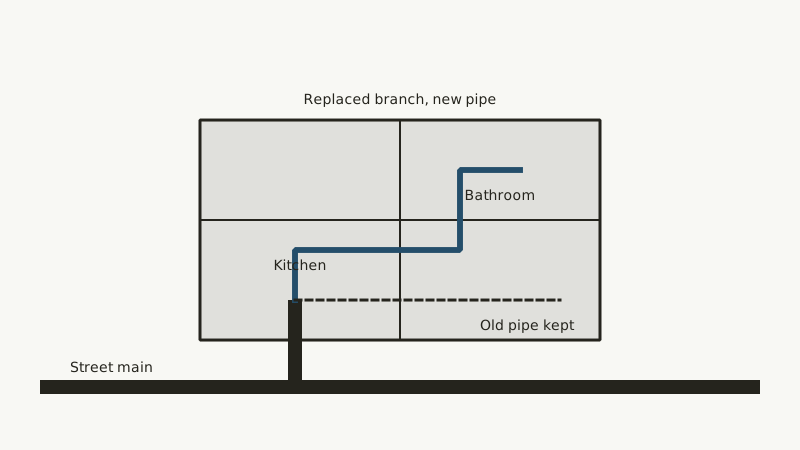
A decent rule: if the failures are random and the pipe is sound, patch. If leaks keep coming from a line made of one aging material, replace the line. Where supply lines run beneath a slab, rerouting overhead is a common alternative, and we weigh that trade-off in fixing a slab leak versus repiping. For the whole-house version of the numbers, see the repipe cost page.
Which material should an old house get, and is PEX allowed here?
PEX is cheaper than copper, typically $3 to $7 per installed foot against $6 to $14 for copper in the guide we used, and it fits through walls with fewer openings. California's Building Standards Commission added PEX water systems to the state plumbing code with an effective date of August 1, 2009. Copper remains a choice when owners prefer it.
Both work. Our write-ups on PEX versus copper and repiping with PEX go into the trade-offs. Gas piping is a separate subject: new gas pipe longer than six feet needs its own permit in Long Beach, and gas work is not part of a water repipe. Should gas ever be smelled during any job, walk out and phone from the street. For Long Beach and Signal Hill the call goes to Long Beach Energy Resources, (562) 570-2140, and most neighboring cities buy from SoCalGas, whose line is 1-800-427-2200.
What about permits, time, and living in the house?
Plan on a permit: Long Beach says water piping work needs one, repiping included, and that inspections must happen before walls are closed. The guide lists permit costs of $100 to $400 depending on jurisdiction. Expect 2 to 5 days for a standard house, up to a week for a larger one with finished walls, with the water off for stretches.
Many families stay home through the work, though some choose to be out during the loudest days. Ask the plumber to plan a schedule that keeps one bathroom and a kitchen tap usable where possible. San Pedro and Wilmington permits go through the Los Angeles building department.
Drywall repair, texture and paint usually come after the plumbing is inspected, which can add days. Sewer and drain pipes are separate from supply piping; Long Beach Utilities says the sewer lateral on your property is the owner's responsibility, so a quote for old drains is a different line.
How do I compare quotes without getting burned?
Have every bidder price an identical scope on paper: which pipes, which material, how many openings, who closes the walls, whether permit and inspection are in the figure, and what happens if hidden damage appears. Only then compare. A low bid that omits wall repair and permits is rarely cheapest.
Search the contractor's name in the state license board's lookup, and insist on a written contract before work begins. Large deposits are a bad sign, because California limits the advance a contractor may ask for on this kind of contract. Once you are ready to collect figures, use the quote page, and the sequence of a whole-house job is described in repiping a house.
Is asbestos a concern when opening old walls?
It can be. Old pipe insulation and wraps from the era are among the materials EPA lists where asbestos may turn up, and you cannot tell by looking. EPA advises treating any doubtful material as if it contains asbestos, leaving it alone, and not sawing, sanding, scraping or drilling it.
If a plumber finds suspect insulation, work in that area should pause until a trained, accredited asbestos professional has looked at it. EPA says removal must be done only by such a professional, and that inspection and removal should be handled by separate firms. Material in good condition that nobody will disturb generally does not need testing, but a repipe disturbs walls, so ask early.
Common questions
Can a house be replumbed while people live in it?
Yes, and most are. The water goes off for parts of each day, and the plumber works room by room. Plan for noise, dust and some days without a kitchen tap. A hotel is a personal call. Tell the plumber about children, pets or health needs so the schedule can be arranged around them.
Do I need to replace everything if only one pipe leaks?
Not necessarily. A single pinhole in sound pipe is a spot repair. Several leaks in the same aging line point to replacing the line. A plumber can judge wall thickness and condition at the failure to say which one you have. The point of testing is to avoid paying for either too little or too much.
Does insurance pay for replumbing?
Seldom for the pipes. Policies may reimburse damage from a sudden burst, yet wear, corrosion and slow leaks are commonly excluded, and wording differs from one insurer to the next. Read yours or ask. The state insurance department publishes plain-language guides on residential coverage.
Why does the same job cost so much more in an old house?
Because access, finishes and unknowns all cost money. New houses have open framing and straight runs. Old ones have plaster, odd routing, mixed pipe and hidden repairs. Labor is most of any repipe bill, and every extra opening or patch adds time. A fair quote for an old house includes room for that.
References
- Plumbing Price Guide, repiping cost 2026 (updated March 2026)
- Published repipe cost guides compared by search, November 2026
- Wikipedia, Polybutylene (use from about 1978 to 1997, failure mode)
- Contractor Magazine, California approves PEX for state plumbing code
- U.S. EPA, Basic Information about Lead in Drinking Water
- U.S. EPA, Protect Your Family from Exposures to Asbestos
- City of Long Beach, plumbing permit requirements
- Long Beach Utilities, sewer backups and lateral responsibility
Updated