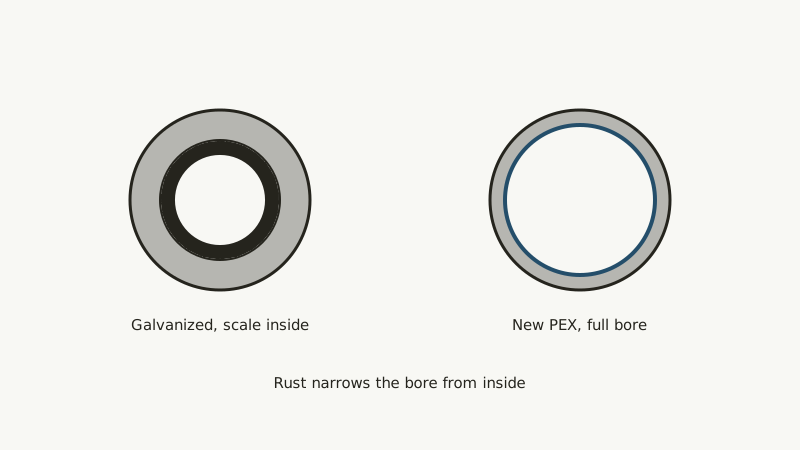
Weak flow, brown tint or a metallic taste in an older house, anything built before the 1960s, often leads back to galvanized steel. The pipe is steel with a zinc coat, and the coat wears away inside over the decades, leaving rust that narrows the pipe and eventually opens pinholes. This article helps you decide between patching and a full repipe, and it covers permits and the polybutylene question that comes up for houses from the 1980s and 90s.
Why does galvanized pipe fail after a few decades?
Zinc shields the steel only until the layer is gone. Wikipedia notes that galvanized plumbing rusts from the inside out, building deposits that cause pressure problems and eventual failure, with a life of roughly 40 to 50 years. Long Beach houses piped in the 1920s through 1950s have usually passed that mark.
Symptoms build slowly: low flow at the farthest faucet, rusty water when you first open a tap after a quiet day, white or orange crust at threaded joints, and leaks that reappear after each patch. Hot lines tend to go first. A single repair on old pipe can disturb the next weak section.
Because corrosion starts at joints and deposits form unevenly, two homes of the same age can age differently. Water chemistry and the thickness of the original zinc layer both matter.
How do I recognize galvanized steel in my own house?
Check exposed runs in the garage, crawlspace and under the sinks. Galvanized is a flat gray, screws together with threaded fittings and attracts a magnet. Copper runs from salmon-pink to green and ignores a magnet, while plastic comes in white, cream, gray or colors. Not sure? A plumber can name it at a glance.
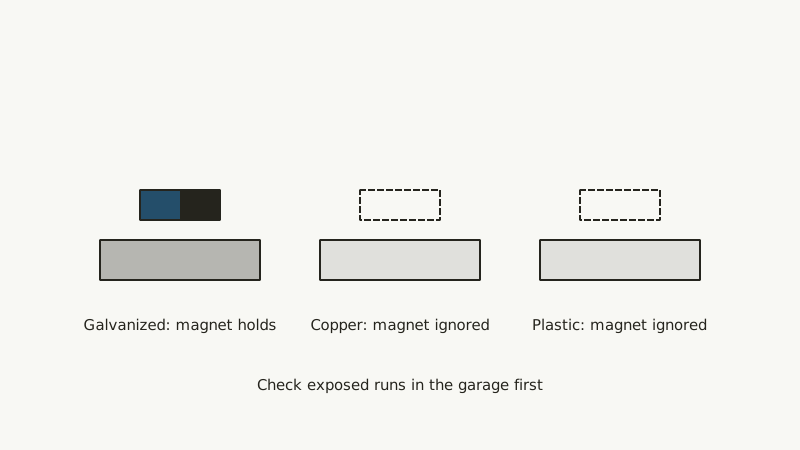
Do not trust the color alone, since old paint and mineral crust hide the metal. Scratching a small spot with a screwdriver in a hidden area shows the base metal. Never cut or disturb pipe you suspect may be old without shutting off the main.
Mixed systems are common in Harbor-area bungalows. Decades of repairs leave copper spliced to steel, and a connection between the two metals corrodes faster unless a dielectric fitting separates them. The plumber's survey tells you how much needs to go.
At what point does patching stop making sense?
Replace when leaks keep returning, pressure has dropped house-wide or rusty water shows up regularly. After the third or fourth patch, swapping whole runs often costs less than another round of repairs. Partial replacement can work if the worst sections are reachable, though remaining steel can still fail.
Ask the plumber to estimate both paths and show the pipe they removed. The same call comes up with leaks under a slab, which the slab leak or repipe page works through. Rule out cheaper causes of weak flow first, such as a failing regulator, using the low pressure checklist.
What replaces galvanized pipe, and what does it cost?
Nearly every repipe now goes in as PEX or copper. Trade press reported California's approval of PEX for household water in 2009, and it has become routine around Southern California. National guides list PEX near $4,000 up to $8,000 and copper near $8,000 up to $15,000. California cities run above that, and one Bay Area guide shows $14,000 to $20,000 for PEX.
Wall repair and permits can account for much of the total. Plan for a lead time and for several days without normal water use. To pick a material, read PEX versus copper and the walkthrough on repiping a house with PEX. Pricing detail sits with the repipe cost breakdown.
A good bid names the material, the number of fixtures, where walls will be opened, who patches them, whether a new main shutoff and pressure regulator are included and who applies for the permit.
Does Long Beach want a permit for this work?
Yes. The City of Long Beach requires a plumbing permit before any installation, alteration or repair work begins, with only small exemptions such as stopping a leak without new materials. A repipe is an alteration, so it needs one. Whoever pulls it needs both a contractor license from the state and a Long Beach business license.
Someone living in a one- or two-family house can apply for the permit and do the labor, subject to the city's conditions, yet a full repipe is hard physical work that most owners leave to a contractor. The inspection protects you either way, and the estimate should name who applies. San Pedro and Wilmington sit in Los Angeles, where LADBS runs its own permit process, so confirm with the right office.
What about polybutylene and the replacement program?
Polybutylene, the gray plastic pipe sold from about 1978 to 1997, is a separate problem. Wikipedia reports leaks linked to chlorinated water and a settlement of Cox v. Shell Oil for $1 billion. We could not confirm that any replacement program is still accepting claims, so do not budget around one. Ask your insurer or a plumber what is on offer today.
Houses built or repiped in those years can still carry it, often under sinks or at the water heater. It is not accepted in current building codes. Our guide to polybutylene replacement covers identification and the repipe options in more detail.
Common questions
How disruptive is a repipe, in days?
Plenty of whole-house repipes wrap up in a few working days, while large homes, finished walls and slab foundations stretch it out. There will be stretches with no running water. Ask the estimate to name those days and say who patches the drywall. Permit and inspection add calendar time.
Is water from old galvanized pipe safe to drink?
Rust is mostly a flow and taste issue, yet old systems can hide lead in fittings or solder, and corrosion can flake into the glass. If that worries you, your water utility can explain testing, and a lab can analyze a household sample. A repipe settles the question for the entire house.
Can one side of the plumbing be done now and the rest later?
Sometimes, since hot lines fail sooner. A plumber can sometimes swap a branch to PEX and leave the rest, but the leftover steel still ages, and joining metals needs care. Ask for a price on a full repipe too, since doing it in one visit often costs less per foot than two.
Does a repipe help resale or insurance?
Inspectors and buyers do look at old plumbing, and a repipe backed by a permit helps a sale. Insurers vary, and some ask about galvanized or polybutylene lines. Keep the permit and invoice, and ask your agent how your policy treats old pipe before and after.
The rest of our guides start from the plumber guide for Long Beach.
References
- Wikipedia, Galvanization (zinc coating, inside-out corrosion, 40 to 50 year life)
- Wikipedia, Polybutylene (use from about 1978 to 1997, failure mode, Cox v. Shell Oil settlement)
- City of Long Beach, plumbing permit requirements
- California Contractors State License Board, hiring a contractor
- Contractor Magazine, California approves PEX for state plumbing code
- Published repipe cost guides for California, checked November 2026
Updated