Either type should last for decades in a Southern California house. What separates them is how the pipe is joined, how cramped the work area is and what you are willing to pay. Type A bends more freely and costs a bit more, and type B is firmer and cheaper. Bids should name the type, so this page lays out the trade-offs before you talk to anyone about repiping a house.
What do the letters A and B stand for?
They name the manufacturing route. According to Wikipedia, type A is cross-linked with peroxide while the polymer is hot, and type B is cured with silane after extrusion using heat and moisture. Type C is produced with electron beams. The ASTM F876 standard asks for 65 to 89 percent cross-linking across the family.
On the job the two feel different. Type A bends easily and tends to spring back, so it turns tight corners with few fittings. Type B holds its coil more stiffly and picks up extra fittings at bends. Both are approved for household water in California, where trade press reported statewide adoption of PEX in 2009.
Neither is the same as polybutylene, the older gray plastic that failed in chlorinated water. Cross-linked polyethylene is a different material with a different record.
How do the fittings differ, and does it matter?
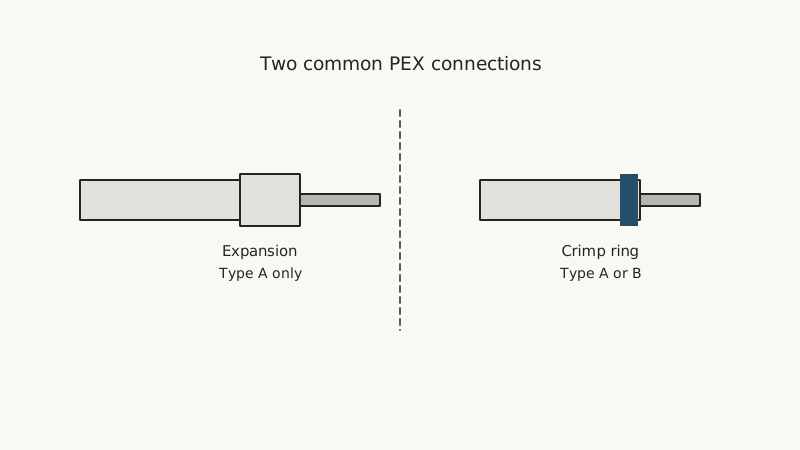
Expansion fittings suit only type A. The installer widens the pipe end with a tool, pushes it over the fitting and lets it shrink tight. Crimp and clamp rings suit either type. An expansion joint leaves a larger opening, while crimp inserts sit inside the bore and narrow it a little.
For a typical house the flow difference is small, but over long runs it can show up in pressure. Plumbers also pick by tool preference. A shop that does mostly new work may use expansion everywhere, while one that does repairs may carry crimp tools in the truck.
Whatever the type, fittings must match the pipe and meet the plumbing code. Mixing brands without confirming approval is a reason inspectors fail jobs.
Which bends easier, and can a kink be fixed?
Type A bends easier, and many guides say a kink can be coaxed out with a heat gun because the pipe tends to recover its shape. With type B the usual cure is cutting out the damaged stretch and adding a coupling. Follow the manufacturer's instructions for heat, since not every guide agrees.
Flexibility matters in cramped places. Bungalows near the Harbor have narrow wall cavities and low crawlspaces, and a repipe there means fishing pipe past old framing. Type A can save fittings and time in that setting, while type B suits straight open runs.
Both types should be supported, kept out of direct sunlight and protected where they pass through framing.
Which costs less?
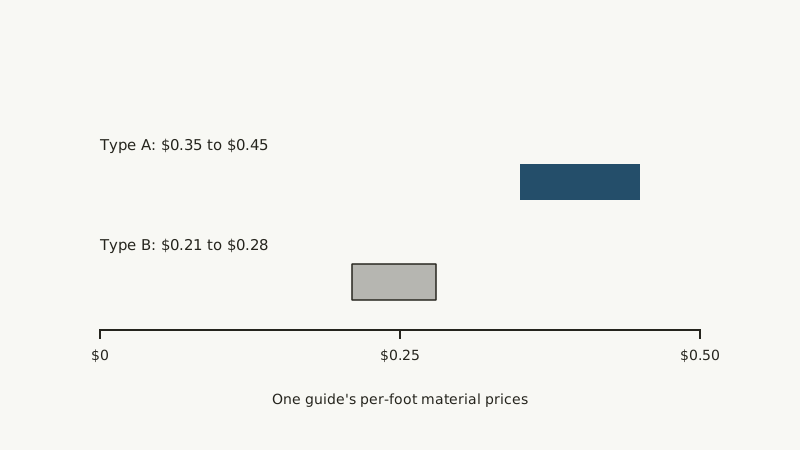
Type B costs less per foot. Guides disagree on how much extra type A commands, quoting anywhere from 10 to 50 percent, and one lists about $0.35 to $0.45 per foot for A against $0.21 to $0.28 for B. Material is a small part of a repipe, so the real cost gap on a house is usually modest. Expansion tools cost more than crimp tools, which can matter to the installer.
For a whole house, labor, wall repair and permits drive the total. Nationwide guides show whole-house PEX jobs near $4,000 up to $8,000, with California cities well above that. The repipe cost breakdown has the ranges. An installer who works faster with type A can offset the pricier pipe.
Ask the bidder to state the type and the fittings so you can compare quotes fairly. Our PEX versus copper article covers the bigger choice of material.
Which resists chlorine and freezing better?
Sources disagree on chlorine. One says type B resists it better, another rates type A excellent and B very good, and Wikipedia notes PEX includes antioxidants but gives no data by type. Treat any claim as unproven and look for the manufacturer's chlorine rating. For freezing, most guides rate type A a little better, though no system is freeze-proof.
Freezing is rare in Long Beach, so it should not decide the question here. Disinfected municipal water does matter for any plastic pipe, so ask the manufacturer which products it lists for your supply.
If you are replacing galvanized steel or polybutylene, see our guides on galvanized pipe replacement and polybutylene replacement.
Which one fits my house?
Pick type A for cramped routing, work inside existing walls or an installer who prefers it. Pick type B for open runs, simple layouts and a tighter budget. The installer's skill and the fittings matter at least as much as the letter. The walkthrough on repiping with PEX shows what the work involves.
Long Beach wants a plumbing permit for a repipe, and the contractor must carry a state contractor license plus a city business license. Look the contractor up on the CSLB lookup. Request a written quote listing the pipe type, fittings, permit and wall patching, and collect two or three.
Common questions
Can both types share a single house?
The pipes can be joined, but only with fittings rated for both. Expansion fittings work on type A alone, while crimp or clamp fittings work on either. Many plumbers stay with one type per job to keep things simple. Ask what the bid uses and where it goes.
How long does PEX last?
Manufacturers often cite decades of service, and PEX has been used in the United States for many years. Real life depends on water chemistry, temperature, sunlight and installation quality. Keep it out of sunlight and avoid contact with chemicals and solvents. Check the product warranty for your type.
Is this tubing fine for drinking water?
Tubing sold for household water must meet the plumbing code's potable water standards, and California adopted it for domestic systems. If taste or odor worries you, ask the plumber which products are listed for drinking water, and flush the lines once the job is finished.
Does PEX need a permit in Long Beach?
Yes. A repipe counts as an alteration, and the City of Long Beach requires a plumbing permit before installation, alteration or repair, with small exemptions. The pipe material does not change that. Find out which party files for it, and keep a copy.
The rest of our guides start from plumber across Long Beach.
References
- Wikipedia, Cross-linked polyethylene (PEX-A, B and C manufacturing methods, ASTM F876 cross-link range)
- Contractor Magazine, California approves PEX for state plumbing code
- City of Long Beach, plumbing permit requirements
- California Contractors State License Board, hiring a contractor
- Published PEX-A versus PEX-B comparison guides from contractors and parts sellers, checked November 2026 (they disagree on some points)
Updated