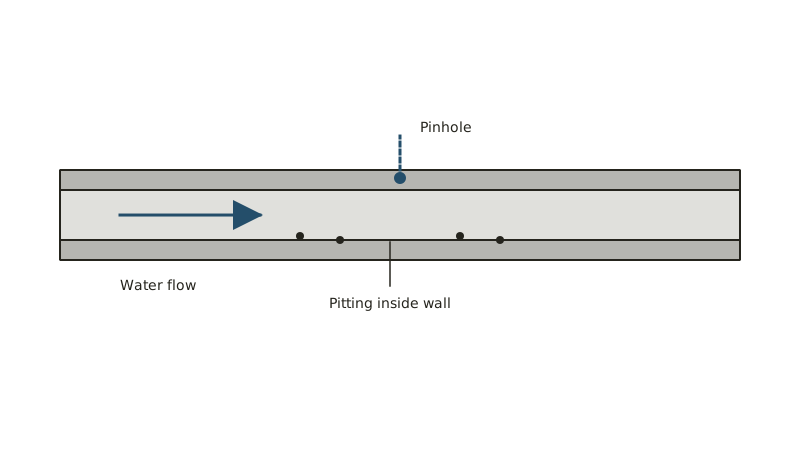
It tends to announce itself as a damp stain, a soft hissing in the wall cavity or a needle-thin spray. First, close whatever valve is closest, or the main valve if there is none nearby. Below: a stopgap, the lasting repair, and a way to judge whether other spots are about to fail. More on leaks in general is on the leak plumbing page.
What can I do about it tonight?
Stop the flow, bleed the pressure off through a low faucet, wipe the pipe dry, then fit a temporary seal. A rubber-lined clamp, stretched self-fusing silicone tape wound with overlap, or two-part epoxy putty pressed over the hole will all hold for a while. None of them replaces the damaged section; they only buy time.
Putty and tape bite best on bare, dry metal, so scrape off the green crust first. A clamp wants a straight stretch of pipe, not an elbow or joint. Reopen the supply gradually, then watch the patch for about fifteen minutes.
In my view these patches should be called what they are, a bridge to a proper repair, because metal around a pinhole is typically thin. The sealant page goes through what each product can and cannot manage.
Spray reaching an outlet, panel or light fixture calls for killing that circuit at the panel first.
How is a pinhole properly repaired?
That means taking out the bad stretch and joining in fresh pipe by soldering or with push-fit couplings, after the line has been closed and emptied. The cut should land beyond the visible damage because adjacent metal is often thin as well. If several spots have given way, longer runs or the whole system are better replaced than patched.
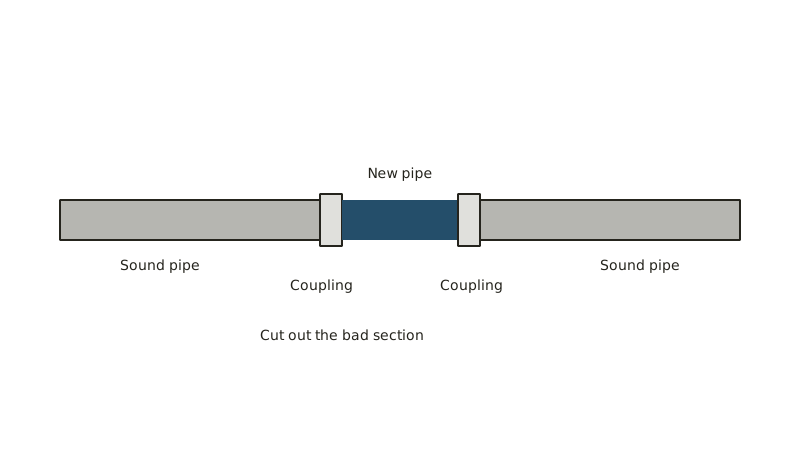
A plumber will usually compare the failed spot with the rest of the line. Pinholes in several places suggest the entire pipe is aging alike, and a single fix may just push the water toward the next weak point.
For scale, Thumbtack's April 2026 guide lists a national average of $234 to $771 to repair a leaking pipe, and a California plumber quoted there priced a copper pinhole at $150 on half-inch pipe and $240 on one-inch. Those are published figures, not our bid; a written price comes from whoever visits.
On permits, Long Beach exempts stopping a leak or a minor repair that uses no new materials. Splicing in new pipe does use materials, so phone Building and Safety at (562) 570-7648 to learn whether your repair needs a plumbing permit. A contractor working under a state contractor license will know how the rule applies to your job.
What eats a hole through copper from the inside?
No one cause fits every house. Work at Virginia Tech connects pinholes to chemistry of the water acting together with flow, a pitting corrosion that digs outward from the pipe's inner wall. Higher pH, chlorine residual, particles in the water and fast flow each showed a part in lab and field tests, and outcomes vary between water supplies.
The same research found that faster flow raised the odds of pitting, with a leak forming in thin tubing in two months at the highest velocity tested. Chloramine's role is less clear: some utilities reported outbreaks of pinholes alongside high chlorine and chloramine levels, while other studies found no link.
For Long Beach, I can report what the city's water quality report lists. Its 2025 table shows a pH of about 8.2 to 8.9 and chloramine as the disinfectant. I cannot tell you that this causes pinholes in your house, because pipe age, installation, flux residue and water velocity all play a part. Anyone claiming a single cause from the street address is guessing.
Workmanship counts too: leftover flux, debris sealed into a line, or pipe that has run hot for decades. Harbor-area homes dating to the 1920s through 1950s can mix several piping materials, so find out what your own pipe really is.
Should I expect a second leak after the first?
Likely, when the pipe has the same age and has carried the same water throughout. One pinhole in a young system may be a lone defect. A second within months, or several together, means pitting is widespread inside the line, and spot repairs will keep arriving.
How to take stock:
- Tally past leaks and their locations, and whether they were on hot or cold lines.
- Look for green or blue-white crust at joints and along runs, a sign of weeping.
- Check water pressure and watch for noisy pipes or hammering, since high velocity and pressure surges can add to wear. A regulator that has failed should be adjusted or replaced.
- Have the plumber examine the piece that was cut out. Heavy pitting on the inside tells you more than the outside does.
EPA reports yearly household leak losses above 9,300 gallons, and a pinhole inside a wall can drip for months unseen. To test, close every tap, record the meter, and read it again two hours on. A moving dial confirms a leak, and leak detection pricing covers a specialist if one is needed.
At what point is a repipe cheaper than more patches?
Consider it around the second or third pinhole, once water damage bills pile up or walls keep being opened. New PEX or copper ends the cycle. The upfront cost is higher, yet it replaces a string of repairs, patching jobs and the chance of a slow leak nobody sees.
Method and price are covered in how a repipe is done, the repipe cost page and the guide to repiping with PEX. Leaks beneath a concrete floor are weighed on the slab leak versus repipe page. If the plumbing is galvanized steel or gray polybutylene, other pages apply: galvanized pipe replacement and polybutylene replacement.
Water damage from a sudden leak may be insured, though the pipe itself rarely is; slab leak insurance explains the typical wording. The quote form is the way to request a visit and a written estimate.
Common questions
Will epoxy hold a leak in copper?
Briefly. Putty over clean dry metal, a clamp or fusing tape can quiet the drip until the section is swapped out. The wall beside the patch may be thin, so it can fail again next to it. Let the epoxy cure fully with the water off before pressurizing.
What will the repair run?
National guides average $234 to $771 for a leaking pipe, and one California plumber quoted $150 for a half-inch copper pinhole. Reach is what swings it: an open garage wall is cheap, tile or plaster is not. Ask for the figure on paper, wall repair included or not.
Does it count as an emergency?
Urgent, though not always dramatic. A thin jet can soak a wall cavity, subfloor or ceiling over a few days, and mold follows. Close the valve, dry things out and book a repair. When water is near electrical gear, trip that breaker first. Larger failures are on the burst pipe page.
Does one fix protect the rest of the pipe?
It does not; the repair covers a single spot. Pipe of similar age carrying the same water may develop further pinholes later. Inspecting the removed section shows how far pitting has gone, which guides the choice between longer new runs and a full repipe.
This guide is one of many on plumber long beach.
References
- Virginia Tech, Influences of Water Chemistry and Flow Conditions on Non-Uniform Corrosion in Copper Tube
- Virginia Tech, Investigation of Copper Pitting Propensity Using Bench and Field Scale Testing
- Thumbtack, burst pipe repair cost guide (updated April 2026)
- Long Beach Utilities, 2025 Annual Water Quality Report
- City of Long Beach, plumbing permit requirements
- U.S. EPA WaterSense, Fix a Leak Week
Updated