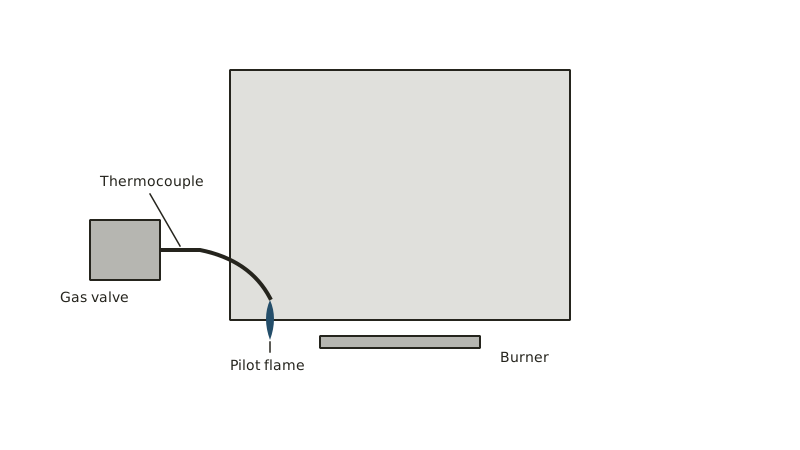
Press the pilot button, watch the small flame catch, count to thirty, release, and the flame vanishes. That sequence implicates the thermocouple: a copper-sheathed rod parked in the flame that reports to the gas valve that all is well. Other heater faults are listed on the water heater repair hub; here we stay with this one part.
What does a thermocouple actually do inside a gas water heater?
It works as a flame-failure safeguard. Warmed by the pilot, the rod produces a faint current that keeps an electromagnet in the gas valve holding open. Should the pilot go out, the current drops, the valve closes, and fuel stops reaching the burner chamber. A worn tip stops producing enough current, so the valve closes even though the flame is burning.
That explains the classic symptom. While you press the pilot button, you are forcing the valve open by hand. The instant you release it, the valve depends on the thermocouple, and a weak one lets go. Hence a pilot that lights without trouble but never survives the release.
Some newer heaters, including flammable-vapor-resistant models, use a thermopile or electronic ignition instead. A thermopile is the same idea with more output. If your heater has no standing pilot and lights with a click or a display, there is no thermocouple to replace.
What proves that this rod, and not something else, has failed?
The behavior is a good first sign, and a millivolt meter turns it into proof. Bradford White's service manual describes an open-circuit test: disconnect the thermocouple from the gas valve, clip the meter between its tip and the copper sheath, hold the pilot lit for about three minutes, and read it. About 20 to 30 millivolts is healthy.
Numbers differ by maker and model, and the same manual describes a closed-circuit test as its preferred method, with a pass reading of 10 millivolts or higher on many models. Use the figures in your own heater's manual instead of a generic number.
Before you buy a part, rule out the cheaper explanations:
- Thermocouple not seated. The tip must sit fully inside the pilot flame bracket.
- Dirty or blocked pilot. A clogged pilot orifice or tube gives a weak or yellow flame.
- Gas supply problem. A closed valve, low pressure or an interrupted supply starves the pilot.
- Failed gas valve. If the thermocouple tests good and the pilot still drops out, the valve or an energy cut-off switch may be at fault.
A heater that has lost its pilot and also trips a temperature cutoff is worth a second look from a pro, since that cutoff exists for safety reasons.
How is the thermocouple replaced on a tank heater?
The swap is simple in outline. Turn the gas valve knob to its off position, close the supply, open the access door, remove the nut that holds the thermocouple at the gas valve, pull the other end from the pilot bracket, seat its replacement in that bracket, and tighten the nut. Relight the pilot afterward following whatever the heater's label prescribes.
Bradford White's manual lists the steps, with a 3/8-inch wrench for the valve-end nut and a tightening rule of finger-tight plus one quarter turn. The new rod must seat fully in the pilot bracket, and it should be routed carefully so it is not pinched by the door or the skirt.
Match the replacement to your heater by model, because lengths and ends vary. Handle the copper gently, since a kinked rod can fail early. The thermocouple nut is an electrical-style connection, not a gas fitting, so the job does not open the gas piping. A manufacturer's manual may label some tasks for qualified service providers, and I would respect that label.
Can a homeowner do the swap in Long Beach, and is a permit involved?
Many homeowners with basic tools do manage it, and Long Beach does not treat it like a replacement. The city says repairing a water heater without disconnecting it is exempt from a plumbing permit, while replacing the heater requires one. Gas piping is a different matter: do not disconnect, cut or alter it yourself.
Call someone in when gas is detectable, when the pilot assembly looks corroded or crumbling, if the burner flame is yellow or lifting, if the closet shows rust, or if the new part does not fit. Tank leaks will not be solved by any part, and urgent water heater leaks are covered separately.
Detecting gas at any stage means everybody leaves, nothing gets switched or lit, and the call is made from outside. Long Beach and Signal Hill gas comes from the city's Long Beach Energy Resources, emergency line (562) 570-2140. The neighboring cities are served by SoCalGas, 1-800-427-2200. When anyone is in danger, 911 comes first.
While the door is open, glance at the straps too. Long Beach requires earthquake anchoring on every water heater, using straps at upper and lower thirds, and the relief valve for temperature and pressure has to stay installed, never capped or removed.
Does an old tank deserve a new heater instead of a new rod?
If the tank is old, spend the money on the heater instead. The Department of Energy-backed Building America summary gives 10 to 15 years as the expected life of a traditional tank heater. At or beyond that age, a thermocouple fix may buy time while the tank corrodes, leaks or loses efficiency.
Questions that tip the decision: Is the tank leaking, rusted at the bottom, or rumbling with scale? Has the pilot trouble come with a weak flame or rotten-egg smell? Are other parts, such as the gas valve or anode rod, also near the end? If yes, plan for a replacement. Age is the subject of how long a heater lasts, and the gas heater replacement cost guide lays out the ranges.
For a younger heater with a failed sensor, a repair visit is reasonable. A plumber arranged through our quote page can test the sensor, the pilot and the valve and give a written price.
The pilot burns fine, so why is the water still cold?
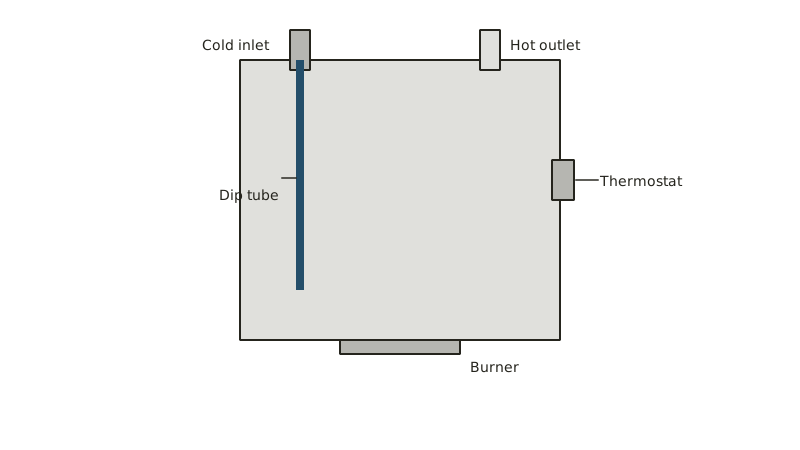
Then the thermocouple is probably fine. Typical suspects: the thermostat setting, a gas valve that never opens to the main burner, a sooted burner, a failed thermostat, or a leaking or failing dip tube that mixes cold water into the hot. Start with the page on a lit pilot but no hot water.
A broader checklist for a heater that produces nothing warm is on the no-hot-water page.
Common questions
Does my own heater even have one?
Look for a small copper rod running from the gas valve to the pilot flame, along with a pilot button or knob. Heaters that light electronically, with a display or a click, have no standing pilot to replace. The label and manual name the ignition type, and a plumber can identify it quickly.
Can I test a thermocouple without a meter?
Behavior hints at it: the pilot burns while the button is held and dies on release. But that also fits a dirty pilot or a gas valve fault. A millivolt reading separates them. A plumber carries the meter and can also check the gas valve, pilot orifice and venting in the same visit.
How long does a thermocouple swap take?
For someone comfortable with it, the repair itself is typically a short job, though gas-safe relighting and checking for leaks adds time. A plumber visit usually includes testing, the part, relighting and a check. Get the price, and its scope, on paper first.
Is a worn sensor a hazard?
This component exists for safety, so a failing one tends to shut the gas off instead of leaving it on. The danger is in the workarounds, such as holding the button down for hours or tampering with the valve. Never bypass the safety feature, and treat any gas smell as an emergency.
For the wider picture, start with plumber across Long Beach.
References
- Bradford White, atmospheric gas water heaters service manual (thermocouple test and replacement)
- City of Long Beach, plumbing permit and water heater requirements
- Long Beach Utilities, gas service and emergency line
- SoCalGas, natural gas leaks
- U.S. Department of Energy, Building America, tankless water heaters (tank heater service life)
Updated