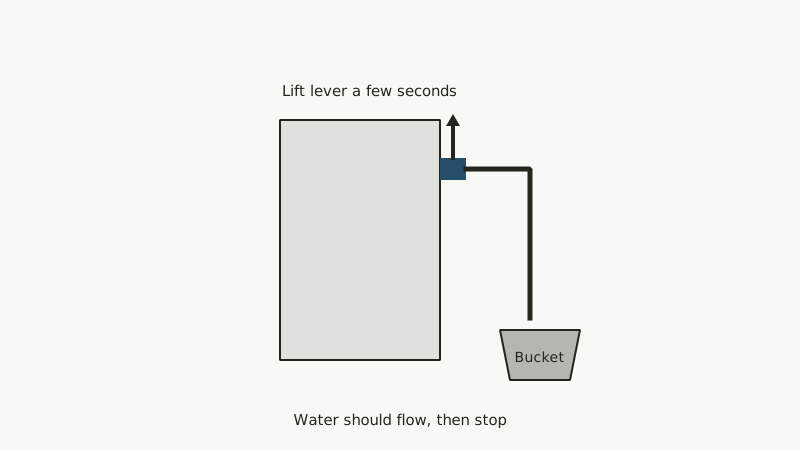
Find the brass fitting up high on the heater, the one with a pipe angled down alongside the tank. That is the T&P valve, short for temperature and pressure, and it opens if the tank runs too hot or builds too much pressure. A drip from it often traces to something outside the valve, which is why anyone doing water heater repair reads the pressure before reaching for a replacement. The sections below cover that check, how the swap goes, and the price. What else we arrange is shown on the Harbor Lights home page.
Does a dripping relief valve mean the valve is bad?
Not necessarily. Four causes show up, from most to least common: thermal expansion in a sealed plumbing loop that lacks an expansion tank, household pressure above 80 psi, a thermostat set too hot, and a worn or mineral-clogged valve. Only the last one is fixed by replacing the valve. The first three will ruin a new valve the same way they ruined the old one.
Water grows in volume as it heats. Put a check valve or regulator at the meter and that growth is trapped in the pipes, so pressure spikes with every heating cycle. Bradford White's manual attributes periodic discharge to exactly this kind of closed system and forbids plugging the outlet. A gauge screwed to a garden spigot gives the household reading; and the state plumbing code sets the ceiling at 80 psi static before a regulator is mandatory. With normal pressure and a thermostat near 120 degrees, suspicion turns to the valve itself. For the regulator side, see water pressure regulator replacement, and for the expansion fix, the page on expansion tank replacement.
How do I test the relief valve, and what should happen?
Park a bucket under the open end of the drain pipe, stand clear, raise the lever for a couple of seconds, then let it drop. A strong rush of hot water should come out and cease the moment you let go. A lingering dribble deserves a few more lifts. Continued dripping afterward, or no flow at all, means the valve is finished.
That water is scalding, so keep kids and animals well back. Bradford White's maintenance section tells owners to check for lime crust, then lift the lever or twist the top several times until the valve seats and stops leaking, and it warns that hot water comes out under pressure. A valve stuck open needs attention before the next shower.
What is the valve for, and what specifications must a new one meet?
If a thermostat fails, this is the final safeguard, venting water or steam before a tank can burst. Its replacement has to be a combination T&P valve listed to ANSI Z21.22, stamped with a set pressure no higher than the heater's maximum working pressure, and able to discharge at least as much as the heater's hourly input rating.
A published guide says home valves typically open at 150 psi or at 210 degrees, whichever arrives first. Do not fit a generic valve from a shelf without matching the thread size and rating printed on the heater's data label. A valve rated too high defeats the purpose. Some heaters have a dedicated threaded port for the valve; it must go in that port, and no shutoff valve may sit between it and the tank, per the manufacturer's manual.
A gas odor around a gas-fired heater is its own emergency. Leave first and call from the street. Long Beach and Signal Hill customers dial Long Beach Energy Resources, (562) 570-2140, while Lakewood, Seal Beach and other neighbors are with SoCalGas, 1-800-427-2200. Dizziness or sickness in anyone adds a 911 call.
How is the valve actually replaced?
First the power comes off at the breaker, or a gas heater is turned to pilot with the gas shut, and the cold supply is closed. Then the tank is partly drained so the level sits beneath the valve. The discharge pipe comes off, the old valve is unscrewed, a new one is threaded in with sealant, the pipe goes back on, and the tank is refilled and inspected for weeps.
Hot water is the hazard. A Rheem service bulletin cited in published guides warns that draining a heater can scald, so let the tank cool if you can. The discharge line stays open: no cap, no plug, no threads at the tip, and it must drain fully. Refill with a hot tap open to bleed trapped air, and finish by raising the lever once to prove the new valve works.
Doing it yourself is a judgment call. The part costs little, but gas and scalding water punish mistakes, and permit rules apply. Long Beach exempts leak stops and minor repairs that use no new materials, and repairs to a heater that is not disconnected; a new valve is a new material, and a full heater replacement needs a permit. Call Building and Safety, 562-570-7648, to ask how a valve swap is handled.
Where does the discharge pipe have to end?
In Long Beach, the discharge line from a T&P valve must terminate between six inches and two feet above the ground, and its end cannot be threaded. The heater must also be strapped against earthquake movement, with accessible cold-water and gas shutoffs. Bradford White's manual calls for the opening within six inches above the floor.
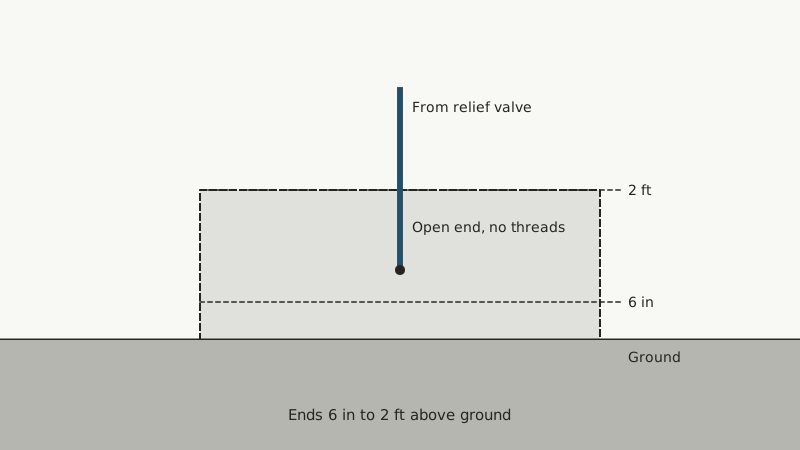
The two statements are not identical, so follow whatever the inspector applies here and have the installer confirm it. In all cases the line runs downhill with no valves or traps, the pipe has to tolerate hot water (copper and CPVC are common), and the outlet must never aim at a person or at live electrical parts. A heater in a garage near a doorway should drain toward the floor, away from foot traffic.
What should a new valve cost, and what inflates the bill?
A cost guide updated in October 2026 shows roughly $15 to $30 for the valve itself and $150 to $300 with a plumber installing it. Search results for other 2026 guides showed comparable bands, a few reaching $350. They are national figures, not a Long Beach quote.
Costs climb when the work goes beyond a swap: frozen threads, a rusted fitting, no discharge pipe, or a finding that pressure is the real culprit. The same guide prices an installed expansion tank at $200 to $400 and a pressure reducing valve at about $300 to $600. On an aging heater, think about how long a tank should last before spending anything. Water here can be tough on tanks, too: one city zone averages roughly 12.8 grains of hardness, and scale plus salt air wear down fittings.
How many years does a valve last, and how often should the lever be lifted?
One guide puts valve life at about 5 to 10 years or more, with hard water and frequent discharge cutting it short. A yearly lever test is the usual advice, and the Watts valve tag cited in manufacturer-related guidance says the same. A valve nobody ever operates is more likely to seize.
Pair the lever test with the other yearly chores: drawing off a little water from the drain and inspecting the anode rod, described in anode rod replacement. When the valve is original on a tank in its final years, replacing both may be the better value. A tank that itself weeps is another problem, handled under water heater leaks.
Common questions
Can I just cap or plug a dripping relief valve?
No. A cap removes the safeguard, and a tank that cannot vent can rupture violently. Manufacturers say never to plug the valve or the pipe below it. When it drips, look for pressure or expansion and cure that. Our quote page takes requests for a visit.
Should any water at all come out of that pipe?
A short burst while the heater cycles can occur in a closed system, yet routine dripping is not normal. It points to expansion, high pressure, an overheated thermostat or a tired valve. A steady stream, or any steam, means cutting the power and water and calling for help.
Is a city permit needed for the swap?
Long Beach requires a plumbing permit before water heating equipment is installed or replaced, exempting minor repairs that add no new materials. Because a valve is a new part, check with Building and Safety, or have the plumber tell you how the city handles it. San Pedro and Wilmington answer to the LA building department.
The valve is spraying hot water. What now?
Step back from the discharge outlet, switch off power or turn a gas unit to pilot, and shut the cold supply feeding the tank. When things settle, call for service. A valve that opens under stress is doing its job, so the real question is what pushed the heater to that point.
References
- Bradford White, water heater installation and operation manual (relief valve ratings, discharge line, testing)
- ReplacementGuide, T&P relief valve replacement cost and causes of dripping (updated October 2026)
- City of Long Beach, plumbing permit and water heater requirements
- California Plumbing Code 608.2, excessive water pressure
- Long Beach Utilities, 2025 water quality report
- Long Beach Utilities, gas service and emergency number
- SoCalGas, natural gas leak safety
Updated