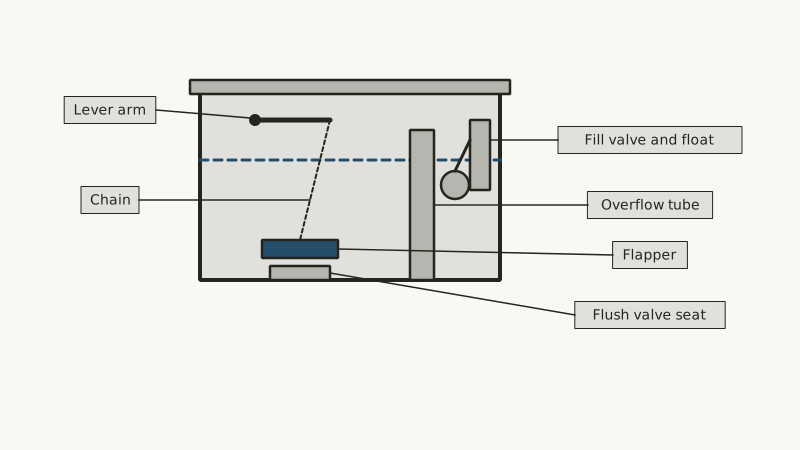
Hear the tank kick on at 3 a.m. with nobody near it? That is a flapper letting go. The part is a palm-sized rubber seal that costs roughly $5 to $20, sits behind a shutoff valve you can close in a second, and swaps in well under half an hour. Ahead: a test that convicts it, a way to pick the right size, a seven-step swap, and the next move if a fresh one fails to cure the leak. The other tank and bowl faults are collected in our toilet repair overview.
How do I prove the flapper is guilty?
Try the mark-and-wait test. Fill the tank, shut the stop valve beneath it, and scratch or tape a line at the waterline. Leave it alone 10 to 15 minutes. A level that has slid below your line means water is slipping under the seal, so the flapper needs replacing. Dye in the tank is a second way to check.
Fluidmaster names the flapper as the usual suspect when a tank empties with the supply closed. EPA's version of the dye check is to color the tank, wait ten minutes and look for tint in the bowl, flushing afterward so the plastic does not stain. Before buying anything, eliminate the fill valve: a stream pouring into the overflow tube blames it instead, and the fill valve repair article takes that up. If the symptom is a tank that kicks on every few minutes, see also why a toilet keeps running.
Why do flappers fail, and how soon is too soon?
Rubber stiffens, warps and gathers a mineral film, and after enough flushes it stops lying flat on the valve seat. EPA's guidance is to fit a new flapper no later than every five years. A chain pulled tight keeps tugging at it, which shortens its life.
Hardness matters locally. Long Beach Utilities reports about 76 ppm in the blended zone and 220 ppm in the other one, and where water is harder, scale can crust the seat until a brand-new flapper cannot close against it. Rubbing lightly with a damp rag or a soft pad smooths a rough seat. Houses near the harbor with their original tanks may also have a seat that has pitted with age, and Korky sells kits for a corroded plastic or brass seat. The stakes are real, since EPA reckons a silent flapper leak costs thousands of gallons over twelve months.
Which flapper fits my toilet?
Measure across the flush valve opening, which is either 2 inches or 3 inches, the larger size showing up on many newer low-flow models. Then carry the old flapper, or a sharp photo of it, into the shop. An adjustable universal flapper suits many tanks, though certain one-piece Kohler models call for a specific design.
Fluidmaster's guide lists an adjustable flapper for 2-inch valves and separate models for 3-inch ones, plus a universal version that converts between the two sizes. Look for the brand and model molded into the tank wall or the lid. Skip the cheapest bin, because a flapper that drops early shortens the flush and one that hangs open wastes water.
How is the flapper swapped, start to finish?
Shut the stop valve, flush until the tank is bare, unclip the chain, pull the old stopper off its pegs, set the new one in, hook the chain back with a little play, then refill and test. Ten to twenty minutes covers it.
- Turn the stop valve clockwise to close it, then flush once so the tank empties.
- Take the chain off the lever arm. Pop the old flapper's side ears off the two pegs on the overflow tube (a few designs collar the tube instead).
- Run a fingertip around the seat at the tank floor. Wipe away slime or crust and feel for pits.
- Lower the new flapper over the opening and snap it on the pegs, then swing it by hand to be sure it moves freely.
- Attach the chain to the arm with roughly a half inch of give. Too loose and the lever cannot lift the flapper far enough; too snug and it hovers open.
- Turn the valve back on, wait for the tank to refill, and flush three or four times, watching that the flapper drops all the way each time.
- Repeat the mark-and-wait test or the dye check to confirm the leak is gone.
Trim any surplus chain so a loop cannot slide under the flapper and prop it ajar. A handle that wobbles or fails to engage is a lever problem, discussed in the loose handle that will not flush.
It still leaks with a new flapper in. What next?
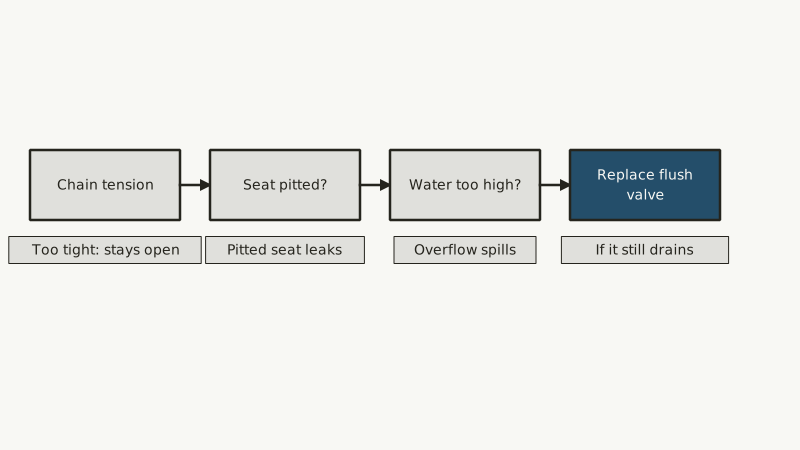
Look at three things in order: chain tension, the seat, and the water level. A tight chain holds the flapper slightly open, a pitted seat leaks around a perfect flapper, and an over-high fill valve spills down the overflow tube. If the tank still drains, Fluidmaster's next step is a new flush valve.
You may not need to pull the tank. A seat repair kit from Korky or Fluidmaster fixes a worn 2-inch seat without removing it, and a flush valve repair that leaves the tank on helps you choose. A tube that is cracked or set low is its own problem, covered in overflow tube repair. Prefer to hand it off? Request a plumber on the quote page. Thumbtack's October 2026 national guide puts a simple toilet repair near $100 to $250, with the parts themselves at $5 to $20. The wider list of work we arrange is on the Harbor Lights home page.
Common questions
How much of my day does this repair take?
Ten to twenty minutes for most people with the right part in hand, since the stop valve isolates the tank and nothing is cut or soldered. Budget a few extra minutes for the refill and the follow-up test. A frozen shutoff or a crusty seat can stretch it, and that is the point to consider calling someone.
What belongs on my list of questions for a plumber?
Ask if the price includes the part, if the seat, chain and fill valve are checked, and what the callout charge is. With a part this cheap, the bill is mostly the visit. Should the plumber find other faults, like a weeping supply line, have them priced separately on paper.
My toilet refills by itself; can I handle that?
Often you can. Begin with the flapper: run the mark-and-wait test, then look for a chain that is snagged or too short. Check the fill valve and the overflow level next. Replace the flapper if the test fails. If the toilet still cycles, that is the moment for a plumber.
Does a leak this small justify the effort?
Yes. According to EPA, a tired flapper can bleed away thousands of gallons annually in silence, and household leaks overall can reach 180 gallons a week. For the price of one rubber stopper, that is among the cheapest ways to save water in a house.
References
Updated