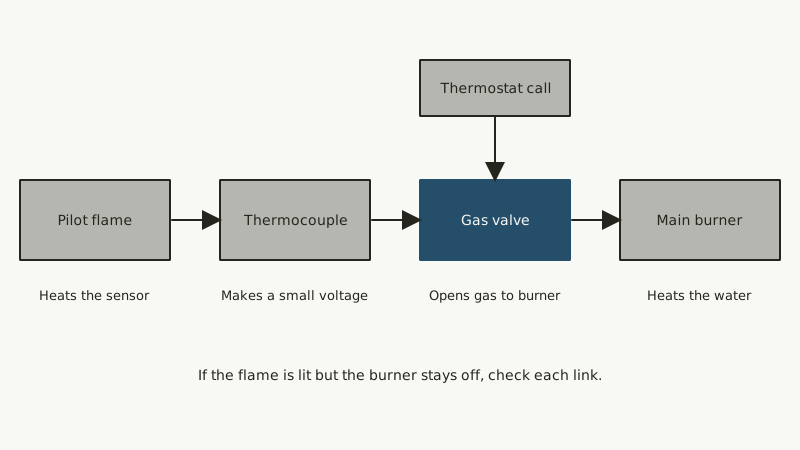
A flame at the pilot with cold water coming out means the main burner is declining to fire. Typical reasons: the thermostat dial is set too low or on pilot, the thermocouple is not telling the gas valve everything is fine, a safety switch has tripped, or the gas valve itself has failed. Start with the dial and the reset button; the rest shifts toward professional work. Faults of every kind, gas and electric, are laid out under repairing water heaters.
The pilot is burning, so why does the burner stay off?
A gas heater lights its main burner only when the thermostat calls for heat and the safety circuit agrees. The pilot flame heats a thermocouple, and that small voltage keeps the gas valve open. A satisfied thermostat, a weak thermocouple or a thermal switch that cut the circuit can each leave you with a healthy pilot and no burner.
Manufacturers draw the line this way. In A. O. Smith's gas valve chart, once the pilot is lit you hold the control knob in for about 60 seconds, release it, and turn the thermostat to the desired temperature, after which the main burner should light. When the burner still does not follow, ask three things: is the thermostat set high enough, has the thermal switch tripped, and does the thermocouple give enough voltage? A pilot that goes out the instant you release the knob has a different, electrical diagnosis, with the thermal switch again the first suspect.
Which quick checks need nothing but my eyes and a finger?
Look at the thermostat dial first and set it comfortably above the pilot or vacation position. Next locate the thermal switch's red reset button, press it and listen for a click. Check that the gas shutoff handle on the supply pipe is parallel to the pipe, meaning open, and read the label for the exact relight steps.
The pilot can be hard to see, so dimming the room lights helps. After relighting as the label directs, hold the knob for the full minute. Peek through the heater's viewing port and see if the burner catches when the thermostat clicks on. DOE's Energy Saver Guide suggests 120 degrees Fahrenheit for a storage heater, which makes a fair target here as well. The moment you smell gas, stop, go outside and make the call described near the end. Nothing in this section involves tools or loosening a gas connection.
Is the thermocouple, the thermal switch or the gas valve at fault?
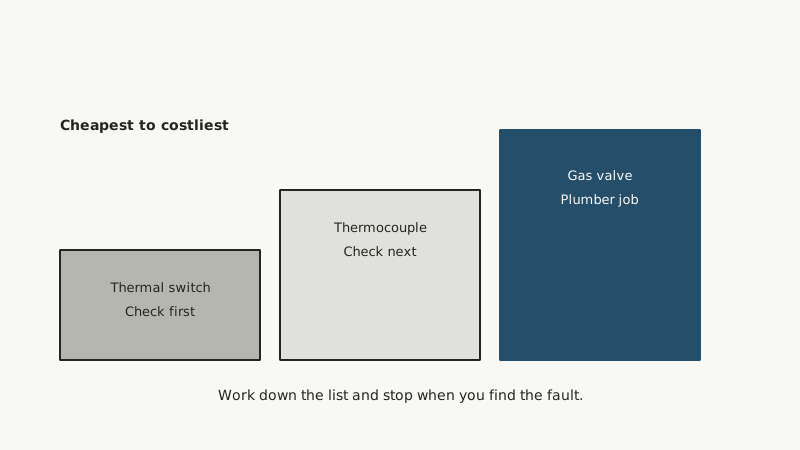
Test in that order, because they are cheapest to most expensive. According to A. O. Smith, if the thermal switch did not trip, measure the thermocouple with a millivolt meter while the pilot is lit: below 10 millivolts means replace it, above 10 with secure wiring means replace the gas valve. If the thermal switch tripped, look at air supply and venting.
| What you find | Likely cause | Who handles it |
|---|---|---|
| Reset button clicks | Thermal switch tripped, often an air or venting problem | Plumber, since it points to combustion air |
| Pilot lit, thermocouple under 10 mV | Worn or dirty thermocouple | Plumber or experienced DIYer |
| Thermocouple over 10 mV, burner still off | Gas valve | Plumber; Bradford White calls the valve non-repairable |
| Status light on an electronic valve does not flash | Electrical fault, reset the thermal switch | Plumber |
A tripped thermal switch is a safety device, so do not just keep resetting it. A. O. Smith's guide says it is likely an air supply problem: a clogged air filter or flame arrestor, too little combustion air in the room, or a venting fault. Conduct a draft test, the guide says, and if smoke from a match or similar source is not drawn into the draft hood after five minutes of burner operation, there is a supply or venting problem. Poor venting can push combustion gases into the room, which puts it firmly in plumber territory; a working carbon monoxide alarm nearby is wise. For parts and cost on the first item, see replacing a thermocouple.
Could the heater be fine and the plumbing be at fault?
Sometimes. If the burner fires and the tank heats but the faucets run only lukewarm or run hot briefly, a damaged dip tube may deliver cold water where it should not go. These are less common than the thermostat and safety checks, so rule those out first.
A quick test: with the heater running, touch the hot outlet pipe on top; if it is hot, the tank is working and the problem lies downstream. Hot water that fades quickly is a separate complaint, usually sediment or a part wearing out. The other causes of a cold tap are ordered in why a house runs cold, and a puddle under the tank is handled in water heater leak repair.
Where do I stop, and who do I call about gas?
Anything that touches the gas valve or gas piping is a plumber's task, and so is the thermocouple. Smell gas? Get out first. Long Beach and Signal Hill customers phone the city's Long Beach Energy Resources on (562) 570-2140. The neighboring cities are served by SoCalGas, reachable at 1-800-427-2200; 911 handles actual danger.
The utility's own advice: leave at once, stay away from flames and switches, and do not try to mend a broken pipe or meter. The City of Long Beach requires a permit for new gas pipe longer than six feet, and a hookup of six feet or less from the outlet to an appliance inside one room is excluded, so replacing a gas valve is not the same as running new pipe, but it is still gas work. Thumbtack's October 2026 guide lists about $395 to clean and repair a thermocouple from one provider and about $150-$200 for swapping a thermostat or heating element, which puts most visits for this fault in the low hundreds. If the heater is old, the cost of a new gas heater is worth comparing, and the quote page brings a local plumber who prices the job on paper first; the Harbor Lights home page shows what else we arrange. Quake risk is the topic of the automatic gas shutoff valve.
Common questions
Why does the flame die the second I release the knob?
That points to an electrical problem in the safety circuit, most often the thermocouple not producing enough voltage or a tripped thermal switch. Press the thermal switch's reset button and try relighting. If it still will not hold, the thermocouple or gas valve needs testing, which is work for a plumber.
Is a feeble pilot flame enough to explain cold water?
Yes. A small, flickering or yellow flame may not heat the thermocouple enough, and dust or rust can clog the pilot tube or orifice. A relight may hold for a day, then fail again. If the flame looks wrong, do not keep trying; a plumber can clean or replace parts and check combustion air.
How often is it fine to relight a pilot that keeps failing?
Occasional relighting by the label's instructions is fine, but repeated failures mean something is wrong, and a thermal switch that keeps tripping is a warning about air or venting. Stop after a couple of attempts and have a plumber check. Never relight if you smell gas, and never bypass a safety device.
How much time does a fix like this need?
A thermocouple swap or cleaning is usually a short visit, while a gas valve replacement takes longer because the connections have to be leak-tested afterward. The plumber will tell you after testing. Ask whether the repair makes sense, given the heater's age, before you approve it.
References
Updated