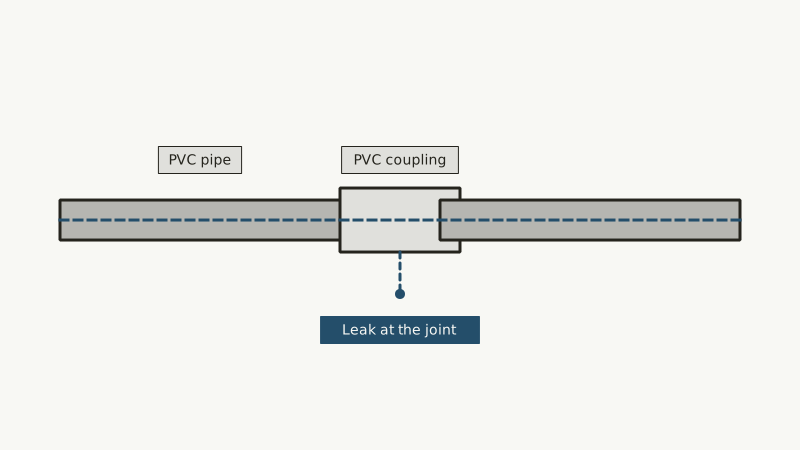
PVC joints leak for a short list of reasons: cement that was never applied evenly, a skipped primer step, a joint that has been strained by shifting soil or a heavy load, a crack in the fitting, or sun damage on an exposed line. A weep at a socket will not close up on its own. Where a pipe is part of the pressurized house supply, it belongs in the family of leaks and burst pipes, and the safe move is to shut water off first.
Before you touch anything, work out what the pipe carries. A drain line, a cold water supply and a sprinkler line fail differently and get fixed differently.
What kind of PVC line is it, and does that change the repair?
Yes. Drain, waste and vent lines carry water by gravity and rarely hold pressure, so a leak shows up only when water flows. Supply and irrigation lines hold constant pressure and leak all day. Hot water lines in most homes are not PVC at all, so finding PVC on a hot line is a red flag the plumber should examine.
Identify the pipe by where it goes. Under a sink or tub, white PVC drain traps are common. In the yard, pipe near a valve box is usually irrigation. Pipe stamped with a pressure rating and a size is supply. PVC is a cold-water material, and the manufacturer's label sets its temperature limits, so never assume a replacement fitting can take heat.
If you cannot tell, treat it as pressurized and shut the supply, then ask a plumber. Salt air near the harbor does not eat plastic the way it eats metal, but sunlight does: exposed irrigation PVC in Long Beach side yards turns brittle and cracks at fittings.
How do I find out exactly where the joint is leaking?
Dry the joint and the pipe around it, hold a dry paper towel against the suspect fitting, then run water or flush the fixture. The first spot where the towel darkens is the source. Water often runs along the pipe before dripping, so check above the wet spot. A weep that shows up only when pressure builds points to the supply.
EPA WaterSense describes a simple meter check for hidden leaks: shut off all water, note the meter reading, wait about two hours and look again. If it moved, a supply-side leak exists somewhere. A joint hidden in the framing or under concrete takes leak detection equipment to find, and our page on leak detection pricing outlines what that visit involves.
Can I seal a leaking PVC joint without cutting it out?
Only as a stopgap. Epoxy putty, a clamp or fusing tape can slow a small weep for a while, but they do not make a permanent joint. A leak in a socket usually means the weld is incomplete, and no coating over the outside fixes that. Plan to replace the joint properly.
Never put new PVC cement over a wet or leaking joint expecting it to seal; solvent cement works by softening the plastic surfaces so they fuse together, and it will not bond through water or over old cured cement. Oatey notes that dried cement cannot be re-coated. For a pressurized line, a temporary clamp gets you through the evening until a proper repair, as long as you watch it.
How do I repair a leaking PVC joint properly?
Turn the supply off and bleed the line. Saw out the leaking joint with a PVC cutter or fine saw, square the ends, deburr them, dry-fit a new coupling or slip repair coupling, then clean, prime and cement both sides according to the label. Hold each joint for as long as the label directs, and give it its full cure before the line sees pressure.
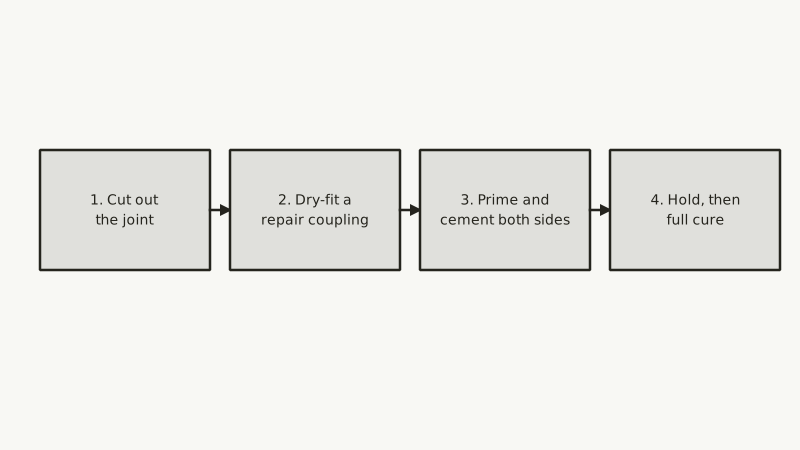
A slip coupling, sometimes called a repair coupling, lets you fit a new section into a fixed pipe without moving either end. Keep the pipe free of water during the work, since moisture interferes with the weld. Oatey's published chart for PVC and ABS cement lists about 15 minutes before pressure of up to 180 psi for small pipe in warm weather, with longer times for bigger pipe, colder temperatures and higher pressures, and says cold weather roughly doubles the wait. Home supply pressure is far below 180 psi, but follow the label on your can and err on the long side.
Do not test PVC with compressed air or gas, as Oatey warns. Turn water back on slowly, then check every joint for a bead of water.
Where is the line between my fix and a professional's?
Bring one in if the joint is boxed in behind drywall or under concrete, if the pipe is the main supply, if it feeds hot water, if the damage is a crack along the pipe instead of at a joint, or if your repair fails twice. Not sure what kind of pipe it is? That counts too.
The professional route brings the right primers, couplings and testing, and covers permit rules. The City of Long Beach requires a plumbing permit for plumbing work beyond minor repairs made without new materials, and most plumbing jobs in California need a contractor license; cslb.ca.gov offers a search. In San Pedro and Wilmington, permits go through LADBS.
A joint that has failed once may point to something bigger: pressure that is too high, a line without support, or a section that moves. The usual factors are laid out in why pipes split. Water already pooling in a room? Use the urgent burst pipe guide. Ready to line up a plumber? Fill in the quote form.
Common questions
What is the elapsed time on a joint repair?
A reachable joint needs under an hour of hands-on work: cut, dry-fit, prime, cement. Then comes the label's cure time before water returns. A hidden joint takes far longer, since it has to be located and opened. An estimate firms up once the plumber sees the pipe.
What do I want in writing for a joint repair?
Pipe type and size, whether access and wall patching are included, any permit, and the method for testing the repair. Check the contractor in the state's license search. Also ask what the plan is should the leak prove larger than it looks.
Will someone need to let the plumber in?
Generally. The water has to go off, the pipe has to be visible, and someone must approve a change if the job grows. When you are out, send a trusted person in your place and keep your phone on. Empty the space beneath the pipe, and keep pets and kids away from the work.
The rest of our guides start from Harbor Lights Plumbing plumber.
References
Updated