Take a home near 2,000 sq ft: published guides price rough-in and finish plumbing together at roughly $8,000 to $15,000, with higher estimates reaching about $21,000 when fixtures are many or high-end. California labor generally runs above national averages, so budget toward the upper half. This guide splits that number into pieces you can check against a bid, while the Harbor Lights Plumbing home page describes our service.
How do plumbers price a new house, by square foot or by fixture?
Both methods show up. Square-foot pricing for rough-in plumbing is commonly quoted at about $4 to $5 per square foot, and fixture pricing at roughly $300 to $1,500 per fixture depending on the source and what is included. Finish work is billed separately. Ask any bidder which method they use and what each line contains.
Why the figures wander: one plumber's "per fixture" price covers drain, vent and supply to a toilet, while another counts only the supply stub. A fair comparison needs the same scope behind each number. A written bid should list the number of bathrooms, kitchens, laundry hookups, hose bibs, water heater and gas connections it assumes.
What are the stages, and what does each cost?
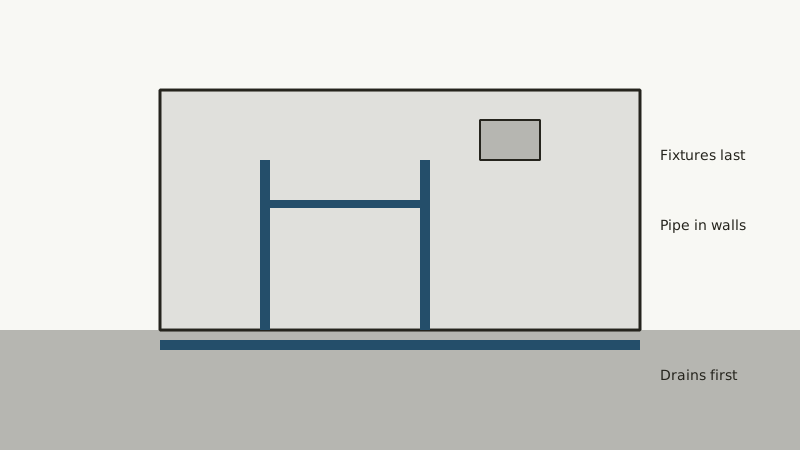
New plumbing has three billing stages. Underground work comes first on a slab house: drain and sewer lines laid before concrete. Rough-in follows, with pipe run inside framed walls and floors. Finish, or trim-out, comes last, when fixtures, faucets and the water heater are connected. Each stage is inspected by the city.
Typical published figures:
| Stage | Guide range |
|---|---|
| Rough-in, whole home | about $4 to $5 per sq ft, or roughly $8,000 to $13,500 |
| Finish and trim-out | about $1,500 to $6,000, depending on fixture count and quality |
| Combined, 2,000 sq ft home | about $8,000 to $15,000, with higher estimates near $21,000 |
| Moving a fixture after rough-in starts | about $500 to $2,000 each |
That last row is the one owners overlook. Decide fixture positions before the plumber starts, because changes made once pipe is in the wall cost real money. A bathroom shifted a few feet is a different job at rough-in stage than on the design drawing.
What makes the cost swing up or down?
Fixture count is the largest factor, followed by number of stories, slab versus raised floor, pipe material, the length of runs and how much of the work sits in awkward spaces. More bathrooms and a far-away water heater lengthen runs. A raised foundation, as found under many older Long Beach neighborhoods, leaves pipes accessible and usually costs less.
Other drivers to ask about:
- Pipe material. PEX tubing is often quoted at about $0.50 to $2 per foot and copper at roughly $2.50 to $6 per foot, before fittings. Long Beach lists copper type L and heavier as allowed everywhere, and PVC is not approved for water lines under or within buildings. Our PEX versus copper comparison explains the choice.
- Fixture quality. A builder-grade faucet and a designer pull-down are different line items.
- Gas piping. A kitchen range, dryer, fireplace, furnace and water heater each add gas runs. Gas pipe cannot run in the ground under a building or in a concrete slab under Long Beach rules, so routing matters.
- Water heater type. A tankless unit needs more gas capacity and vent work than a tank. See the tank versus tankless guide.
- Utility connections. Meter and service line work, and any capacity fees, may be separate from the plumber's bid. Ask the water utility what applies, since Long Beach and Los Angeles each serve parts of the Harbor area.
What does the city inspect, and what permits are needed?
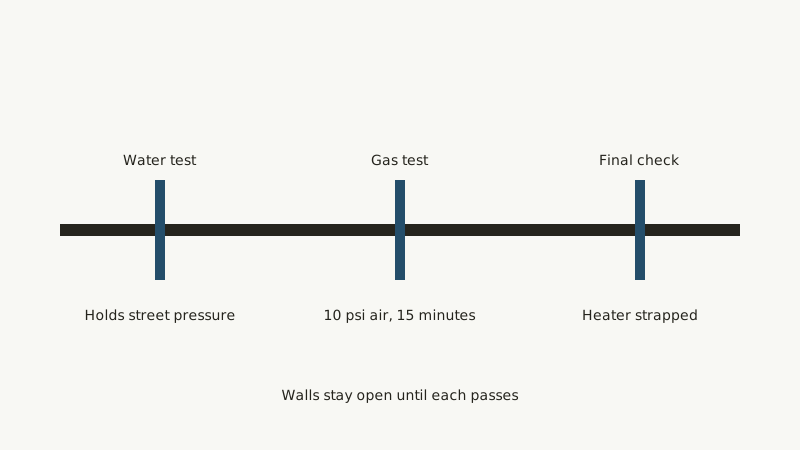
Long Beach requires a plumbing permit before installing or altering piping, gas and fixtures, and all work must be inspected before it is covered. Rough plumbing is checked while walls are open, gas piping is pressure tested before it is concealed, and a final inspection follows. A single permit can cover several trades on one- and two-family homes.
Specifics the city spells out:
- Water piping must hold street pressure or 50 psi of air without leaking.
- Metallic gas piping must hold 10 psi of air for at least 15 minutes, witnessed by an inspector, before anyone covers it. Gas systems are never tested with water.
- Gas pipe in the ground needs corrosion protection, and horizontal metallic runs need at least 12 inches of cover.
- Water heaters need earthquake strapping, a relief valve with a proper discharge and a cold water shutoff.
- Hose bibs need a non-removable backflow device.
Ask the plumber who applies for the permit and who books each inspection. Expect the contractor to show a California license, and put any job over $500 in a written contract. Any deposit must stay at or below the smaller of $1,000 and ten percent of the contract.
How do you get ready for plumbers on a new build?
Have the plans settled, fixture models chosen and the schedule shared with the builder. Plumbers need clear access, framing ready for pipe, and a water source on site. Finalize the number and location of fixtures, hose bibs, laundry boxes and gas stubs before rough-in so that nothing has to move once walls are drawn.
A useful checklist to give each bidder:
- Plan set with bathrooms, kitchen, laundry and any outdoor kitchen or ADU marked.
- Fixture schedule, including shower valve brand if you have a preference.
- Water heater type and location, plus gas or electric supply.
- Foundation type and who is doing the underground work.
- Who supplies fixtures: the plumber or the owner.
- Any extras, such as a recirculation line, water softener or filtration, or an outdoor shower.
Maintenance access deserves a thought too. A shutoff valve behind a locked cabinet or an access panel at the tub valve costs little now and saves a wall later.
For a written number on your own plans, use the quote form. Compare the result with our general plumbing cost overview and, for the heater, the water heater replacement costs. If a problem appears at night, remember that our phone line answers on weekdays in office hours, so close the supply valve first and call the next business day.
Common questions
What is a realistic budget for an average-size house?
Guides give roughly $8,000 to $15,000 for rough-in plus finish, and some estimates climb to $21,000 with many fixtures or premium choices. In California lean toward the upper half. Your plans, fixture list and foundation decide the real price, so compare written bids built on the same scope.
Is rough-in or finish plumbing the bigger cost?
Rough-in is. Guides put it near $8,000 to $13,500 for a typical home, while finish and trim-out run $1,500 up to $6,000. Rough-in is labor-heavy and includes pipe, fittings, drains and vents. Finish cost depends mostly on the fixtures you choose.
Does a new house need a separate gas plumber?
Usually the plumbing contractor handles gas piping too, since in California it falls within plumbing work. Gas pipe means a permit, a pressure test the inspector witnesses, and sign-off before it is covered. Ask the bidder whether gas runs are in the quote or priced as an extra.
Can I save money by supplying my own fixtures?
Sometimes, but not always. You may find lower prices, yet plumbers can add a handling fee, decline to cover parts they did not supply, and delay the job if a fixture arrives wrong. Choose models before rough-in so the right supply and drain positions are set.
References
- City of Long Beach, mechanical, electrical and plumbing code requirements
- City of Long Beach, permit questions
- California Contractors State License Board, home improvement contracts
- Published new construction plumbing cost guides from several estimating and cost sites, checked November 2026
Updated